 how-to
How to Interpret College Coach Feedback During Recruiting
Last Updated: November 4, 2026
Quick Summary
Coach feedback usually falls into four buckets: strong interest, still evaluating, roster-dependent, or a polite pass. Look at what the coach asked you to do, since a request for film, grades, or a call is a real signal. A compliment by itself is much weaker than a concrete next step.
- Initial evaluation signals include a coach asking for your film, stats, academics, or schedule.
- Meaningful interest signals include repeated communication, specific roster questions, direct calls, or personalized feedback.
- Strong interest signals include visit discussions, admissions or financial aid conversations, a clear timeline, explicit roster fit, or offer-related conversations.
- A request for film, grades, or a call is a real signal worth acting on.
- Ask where you fit on their board for your position and class year.
- Follow up within a day or two with a short email thanking the coach and sharing an update.
- Track each school, coach, message, and date in a simple spreadsheet so you don't go silent for months.
Table of Contents
- Start by Figuring Out What Kind of Feedback You Got
- Questions to Ask College Coaches During Recruiting
- Follow Up With College Coaches and Track Your Recruiting Timeline
- What Coach Actions Mean More Than Coach Words
- Frequently Asked Questions
Start by Figuring Out What Kind of Feedback You Got
Coaches do not always communicate interest or rejection in direct terms, especially early in the process. Most of what you hear sits somewhere in the middle, and that's where things get confusing. Learning to sort the feedback is the first step to knowing what to do next.
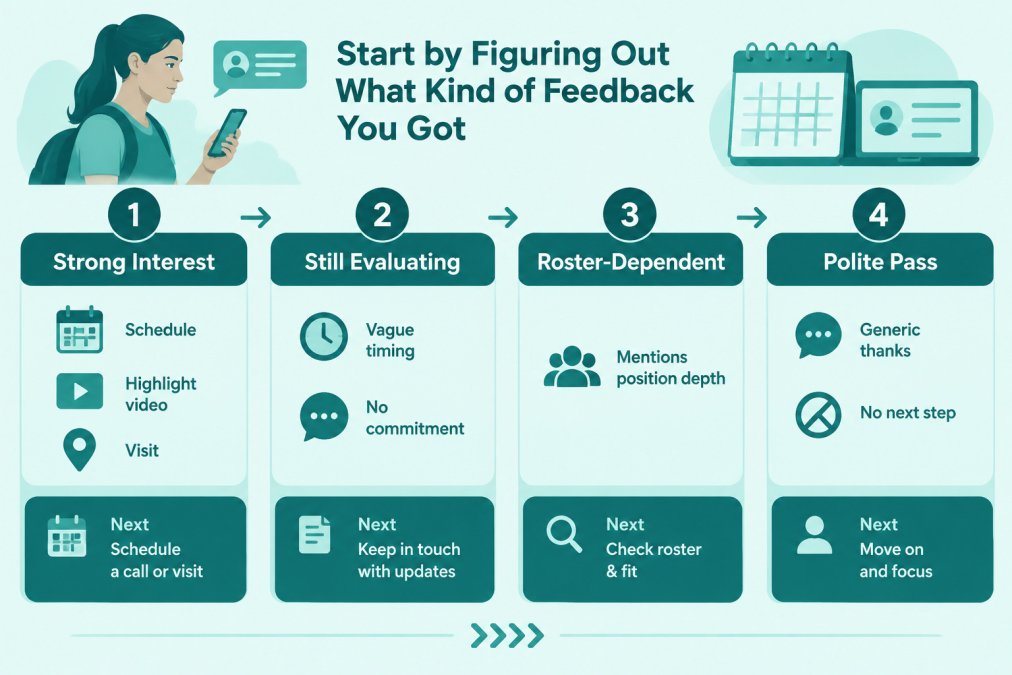
Think of it as four buckets. Initial evaluation signals include a coach asking for your film, stats, academics, or schedule. Meaningful interest signals include repeated communication, specific roster questions, direct calls, or personalized feedback. Strong interest signals include visit discussions, admissions or financial aid conversations, a clear timeline, explicit roster fit, or offer-related conversations. Still evaluating sounds like "we're watching your progress" with no timeline attached. Roster-dependent sounds like "we'll see how our depth chart shapes up." A polite pass sounds like a thank-you with no next step at all. Navigating these varied responses requires a resilient mindset, as the ability to remain composed while overcoming mental blocks often determines whether a recruit maintains their momentum or loses focus during the uncertainty of the process.
Here's the trick. Look at what the coach asked you to do. A request for film, grades, or a call is a real signal. If you're not sure which warning signs actually matter, see the common red flags to watch for. A compliment by itself is much weaker than a concrete next step.
Coach feedback usually falls into one of four buckets, and each one calls for a different next step.
| Feedback type | What it sounds like | What it signals |
|---|---|---|
| Strong interest | Asking for your schedule, highlight video, or a visit date | A real signal to act on |
| Still evaluating | "We're watching your progress" with no timeline | Keep developing and staying in touch |
| Roster-dependent | "We'll see how our depth chart shapes up" | Your spot depends on other players |
| Polite pass | A thank-you with no next step | Move your focus to other programs |
Questions to Ask College Coaches During Recruiting
Asking good questions tells a coach you're serious and gets you the answers you need to read their feedback accurately. See what current athletes say they wish they had asked about coaches.
Start with the basics. Ask where you fit on their board for your position and class year. Ask how many players they plan to sign at your spot. Ask when they expect to make decisions.
Keep your tone friendly and direct. Coaches respect players who ask clear questions.
Follow Up With College Coaches and Track Your Recruiting Timeline
Follow up after every real conversation. Learn how to keep coach communication organized and effective. A short email within a day or two works well. Thank the coach, restate one thing you learned, and share an update on your season or film.
Keep a simple spreadsheet logging each school, the coach's name, what they said, your next step, and the date of every message so you don't go silent for months.
Watch for staff changes too. A new coach can shift a program's priorities fast. If your contact leaves, reach out to the new staff member and ask where your file stands.
Your timeline matters as much as your messages. Plan your follow-ups around season milestones, camps, and key dates. Check in every few weeks instead of waiting for them to reach out.
Want a clearer view of where you stand with each program? Explore how RecruitMyGame keeps your contacts, film, and coach updates organized in one place.
What Coach Actions Mean More Than Coach Words
Words are easy to say, and coaches know it. The strongest signals come from what a coach does, not what a coach says.
Watch for repeated direct communication instead of a single message. A coach who asks for your transcripts or academic records is doing real work on your file. The same goes for a coach who speaks with your club or high school coach, since that's a step a casual recruiter skips. Discussing specific roster needs, inviting you for a visit, and giving you a decision timeline all point the same direction. Explaining scholarship or admissions steps is another sign the coach is thinking past the first conversation. And watch who starts the conversation: a coach who follows up without you reaching out first is showing real interest.
Frequently Asked Questions
What does it mean when a college coach says they are still evaluating you?
It usually means the coach has not made a final decision yet. You may still be under consideration, but the level of interest can vary. Coaches often evaluate athletes through the season, watching game film, checking academics, and talking with their staff before deciding. Don't read it as a no. Instead, send a short update with your latest film, your schedule, and one specific question about their roster timeline. If the coach is actively evaluating you, a relevant update gives them a reason to re-engage and may help clarify where you stand. A coach who has already moved on will usually go quiet or give a vague answer, and that tells you something too.
How long should you wait for a college coach to respond?
Give a coach about one to two weeks before following up, since staffs are busy and recruiting emails pile up fast. If you hear nothing after your second message, it's fair to send one more short note and then shift your energy to other programs. Keep the recruiting calendar and your sport's contact rules in mind before interpreting silence too aggressively. Silence is often a signal of low priority, not an insult. Keep your follow-ups brief, polite, and specific so the coach can respond quickly if they're interested.
How can you tell if a college coach is genuinely interested in recruiting you?
Look for action, not just compliments. A genuinely interested coach asks for your highlight video, your academic info, or your schedule, invites you to a camp or visit, and mentions your position needs or a next step by name. Warm words like 'you're a great athlete' without any follow-through usually mean they're being polite.