 how-to
Managing College Coach Communications Effectively
Table of Contents
- Why Managing College Coach Communications Effectively Changes Your Recruiting Results
- The Channels Coaches Actually Use and How to Pick the Right One
- College Coach Email Examples You Can Adapt Today
- What to Text a College Coach (And What to Keep Out of a Text)
- A College Recruiting Communication Timeline by Stage
- Tracking College Coach Communications Without Losing Your Mind
- Reading Coach Responses, Silence, and the Roles Parents Play
- Frequently Asked Questions
Last Updated: October 20, 2026
Why Managing College Coach Communications Effectively Changes Your Recruiting Results
Managing college coach communications effectively is the difference between a recruit who gets remembered and one who quietly slips off a board, because the recruiting process rewards athletes who treat outreach like a job rather than a hobby.
Here is what most guides get wrong: they treat this as a volume problem and tell you to email more coaches. The NCAA recruiting guide for student-athletes lays out the contact rules you are working inside, so knowing them changes how you plan every message.
Below, we walk through the channels that actually work, the templates worth stealing, and a tracking system that keeps a multi-month recruiting process from falling apart.
The Channels Coaches Actually Use and How to Pick the Right One
Email is the default channel for first contact and anything involving attachments, but text messages and direct messages have their place once a coach has replied to you, and phone calls are where real interest usually gets confirmed.
The mistake we see most often is treating all four channels as interchangeable, when each one actually has a job.
- Email: first contact, film links, transcripts, and anything a coach may need to forward to an assistant.
- Text message: quick logistics, camp confirmations, and short updates after a coach has already engaged.
- Direct message: a light touch on social media, best used to point a coach toward your email rather than to make your pitch.
- Phone call: the conversation where a coach tests your maturity, so prepare for it like an interview.
A useful rule of thumb is to follow a coach's lead. If a coach gives you a cell number, use it. If they only list a program email, stay in email until they invite you elsewhere.
Email, Direct Messages, and the Phone Call That Follows
Think of your first email as the resume and the phone call as the interview, so the email earns the call by being short, specific, and easy to act on.
When a coach replies and suggests a call, that is a genuine sign of interest. Show up prepared with questions about the program, the roster, and what they are looking for at your position. Have your schedule and your academic record handy. The NCAA eligibility center resources is worth reviewing before that call so you can speak clearly about your academic standing.
One insider note: coaches remember the athletes who ask thoughtful questions far more than the ones who only talk about themselves.
College Coach Email Examples You Can Adapt Today
A strong college coach email is short, personal, and built around one clear reason you are writing to that specific program, and the most effective messages run under 150 words with a subject line naming your position and graduation year.
Below are two examples you can adapt. Swap in your own details and keep the structure.
The Introductory Email That Earns a Reply
Subject: 2028 Point Guard, 6'1", Interested in [Program]
Coach [Last Name],
My name is [Name] and I play point guard at [High School] in [City, State]. I'm graduating in 2028 and I'm very interested in your program.
I've watched your team's pace and how your guards push in transition, and I think my game fits that style. My film is here: [link]. My current GPA is [X.X] and I plan to study [major].
I'd love to know what you're looking for at my position in the 2028 class.
The key move here is the specific reference to how the team plays. It proves you did homework rather than blasting the same email to fifty programs.
The Follow-Up Email That Does Not Feel Desperate
Subject: Following up, [Name], 2028 PG
Coach [Last Name],
I wanted to share a quick update: our season starts next week and I've added two new film clips from fall league to my profile [link]. I'm also now at a [X.X] GPA.
I know this is a busy time of year.
That last line is doing a lot of work, because it gives the coach an easy out, which paradoxically makes a reply more likely, and it signals maturity. Following up once after two to three weeks is normal, but following up weekly is the fastest way to get filtered.
What to Text a College Coach (And What to Keep Out of a Text)
Text messages work best for short, logistical updates after a coach has already replied to your email, and they should stay brief, professional, and free of anything that reads as casual or careless.
Good texts look like this:
- "Coach, confirming I'll be at your camp on the 14th. Thanks for the invite."
- "Just posted new film from last night's game to my profile. Here's the link if you have a minute."
- "Thank you for the call today. I'll send my transcript this week."
What to keep out of a text:
- Anything longer than a few sentences (that belongs in email)
- Slang, emojis, or all-caps
- Questions about scholarship money before a coach raises it
- Multiple texts in a row if you do not get a reply
The NCAA guide on recruiting rules and contact is the place to confirm what communication is permitted at each stage of your recruiting timeline, because rules change by division and by sport. When in doubt, default to email, which is always safe and always easy for a coach to forward to the right staff member.
A College Recruiting Communication Timeline by Stage
The right communication cadence changes as you move through high school, and building a simple communication calendar by recruiting stage keeps you from either going silent for months or overwhelming a coach who is still evaluating you.
| Stage | Primary Goal | Cadence | Best Channel | Key Move |
|---|---|---|---|---|
| Freshman year | Build profile and film | Monthly profile updates | Get your film and grades organized before you contact anyone | |
| Sophomore year | Introduce yourself | One intro email per target school | Send a short, specific intro and ask what they look for at your position | |
| Junior year | Build real relationships | Follow-up every 3-4 weeks | Email, then text | Add something new each time: film, a stat, a test score, a camp confirmation |
| Senior year | Close and commit | Weekly check-ins with top schools | Email and phone | Narrow to a serious list and confirm official visit and offer timelines |
The logic is simple: early on you are building a body of film and grades worth talking about, so your communication is really profile maintenance, then sophomore year shifts into introductions where the goal is to get on a board before the coach has filled it.
A few stage-specific mechanics are worth spelling out. The NCAA recruiting guide for student-athletes is the place to confirm what is permitted at each stage, and it is worth checking before any major push.
Tracking College Coach Communications Without Losing Your Mind
A simple tracking system is the backbone of managing college coach communications effectively, because once you are talking to fifteen or twenty programs, memory alone will fail you and you will either double-email a coach or forget a program that was genuinely interested.
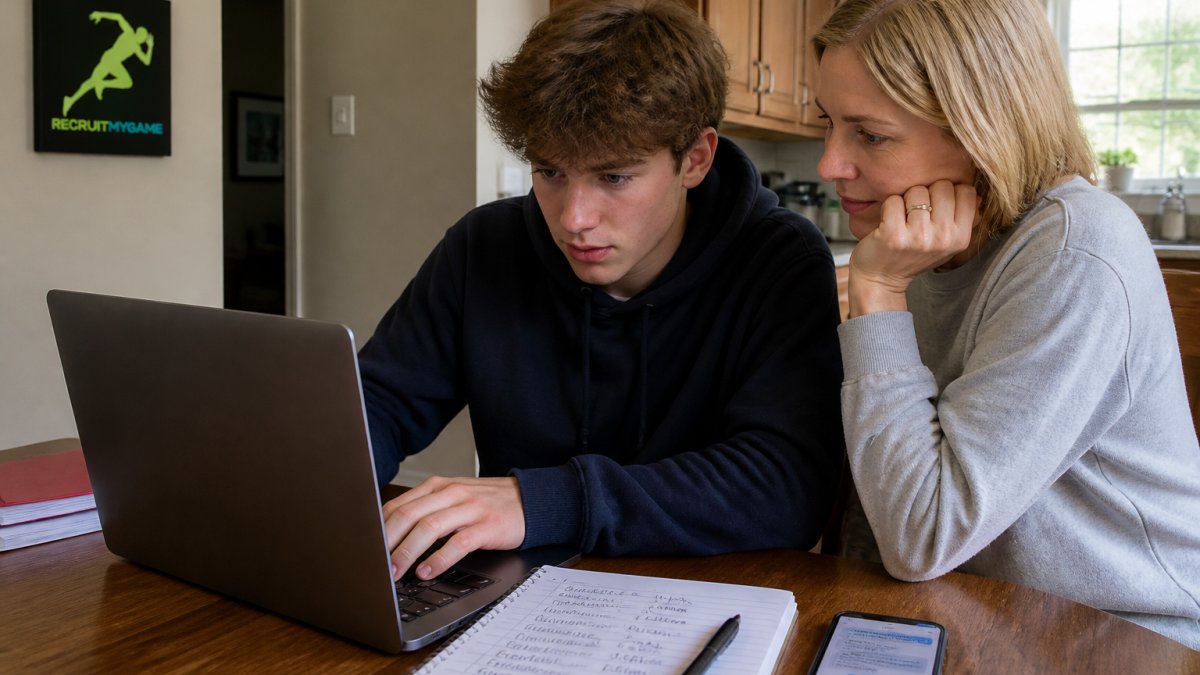
You do not need fancy software to start. A spreadsheet with these columns will carry you a long way:
- Program and coach name
- Position need and graduation year
- Date of last contact
- Next follow-up date
- Response status (replied, no reply, invited to camp, requested film)
- Notes (what they said, what they asked for)
That is the skeleton, but the system only works if you log the right details.
Adaptable scripts make the tracker more useful because you are not rewriting from scratch each time.
RecruitMyGame's tracking and analytics are designed to address this problem, because roster needs, coach tenure, and graduation timelines all shift, and a program that had no room at your position last fall may have a real opening this spring.
The single most useful habit in recruiting is knowing, at any moment, which programs you have contacted, when you last heard from them, and what your next move is. A tracker plus three adaptable scripts turns that habit into a repeatable process instead of a scramble.
Reading Coach Responses, Silence, and the Roles Parents Play
A coach's reply, or lack of one, is information, and learning to read it accurately will save you months of misdirected effort.
Here is how we would interpret the signals:
- A quick reply with specific questions: genuine interest. Respond within a day.
- A short reply with a camp invite: they are evaluating you but not yet recruiting you. Go if it fits your budget and schedule.
- A reply that says the roster is full at your position: believe them, thank them, and move on.
- Silence after two follow-ups: treat it as a soft no and redirect your energy.
Parents play a real role here, but it is a supporting one. The athlete should be the one writing the emails and taking the calls, because coaches are evaluating the athlete's communication skills as much as their film.
A note on safety: keep all communication on official program channels and be cautious with anyone who claims to represent a program without a verifiable staff page. The FTC guidance on avoiding scams is worth a read for any family navigating online recruiting, since recruiting fraud is a real and growing problem.
The recruiting process asks a lot of a teenager, and the communication piece is where most families feel the most scattered.
Frequently Asked Questions
How often should I follow up with a college coach before it becomes annoying?
Give a coach roughly two weeks after an introductory email before sending a short follow-up, then space subsequent check-ins out to every three to four weeks unless something real changes, like a new highlight video, an updated GPA, or a strong tournament performance. Each follow-up should carry new information rather than just asking if they saw your last message. If two or three follow-ups go unanswered, shift your energy to programs showing genuine interest. Managing coach communications well means knowing when to keep pushing and when to move on.
Should parents communicate with college coaches directly, or should the athlete handle it?
The athlete should be the primary voice in every conversation, because coaches are evaluating whether a recruit can handle independence and represent a program. Parents can help behind the scenes by proofreading emails, keeping the communication tracker updated, and managing travel logistics for visits and camps. A parent stepping in to argue, negotiate, or chase a coach for answers usually backfires. The cleanest approach is for the athlete to send the message and for parents to speak up only when a coach specifically invites the family into the conversation.
What should I include in an email to a college coach?
A strong message covers five things in a tight package: your graduation year and position, your athletic profile with a link to film, your academic record including GPA and intended major, one specific reason you fit that program, and your contact information. Keep the subject line plain and searchable, something like your name, position, and graduation year. Attach nothing heavy and paste the film link directly in the body. Coaches skim, so lead with the facts that decide whether they keep reading.
Why are college coaches not responding to my emails?
Silence usually comes down to three things: the program has no roster need at your position, your message read like a mass send with no program-specific detail, or the timing landed outside a period when coaches can reply. Before you send another note, check the roster for graduating players at your position and confirm the contact rules for that division and your graduation year. Then rewrite with one concrete detail about their program. A short, specific message about a real need gets read far more often than a long generic one.