 how-to
How to Verify a College Coach's Communication Style
Last Updated: November 5, 2026
Quick Summary
To assess a college coach's communication style, read the messages the coach already sends, then test one channel at a time and track response time and reply quality. Separate style signals like speed and tone from real interest signals, such as requests for film, a visit, or a next step. A simple scorecard keeps the comparison fair.
- Read the coach's own outreach for message length, tone, format, and preferred channel.
- Test one channel at a time and log response times in a simple table.
- Treat slow replies as style signals, not proof of disinterest.
- Real interest shows up when a coach asks for film, transcripts, a visit, or a next step.
- Score each program on a 1 to 5 scale with one line of evidence per factor.
Table of Contents
- Why Knowing a Coach's Communication Style Matters
- Step 1: Read the Coach's Own Outreach
- Step 2: Find the Coach's Preferred Channel, Then Track the Response
- Step 3: Tell Communication Style Apart From Real Interest
- Step 4: Build a Simple Verification Scorecard and Respect Boundaries
- Booking Your Next Coach Conversation With a Plan
- Frequently Asked Questions
College coaches often receive substantial recruiting correspondence, and the way they handle it tells you a lot. Some reply in an hour. Others take a month, or never reply at all. Before you spend months chasing one program, it helps to understand a coach's communication style and whether that style fits how you work. This guide from RecruitMyGame shows you how to check a coach's communication style without guessing, and how to tell that apart from real interest in you.
Why Knowing a Coach's Communication Style Matters
Every coach has habits, and their coach communication style shows up in how they like to be contacted. Some want short texts. Others want a detailed email with film links. A few prefer a phone call and nothing else. If you send the wrong kind of message, you can look like you did not do your homework, even when you did.
Knowing the style also saves time. You stop waiting on a channel the coach never checks. You stop sending long emails to someone who only reads quick texts.
A slow reply does not always mean no interest, and a short reply does not always mean a coach is bored with you. This guide will show you how to keep style and interest apart.
Step 1: Read the Coach's Own Outreach
Start with what the coach already sends out. Look at the messages they post, the camp emails they send, and the recruiting material on the program site.
Pay attention to these details:
- Length: Are their messages short and direct, or long and detailed?
- Tone: Do they sound casual, formal, or somewhere in between?
- Format: Do they use bullet points, a questionnaire link, or plain paragraphs?
- Channel: Which method do they use most to reach athletes?
Write down what you notice. A coach who sends a three-line email with one question may prefer a quick, clear reply. A coach who sends a long, structured packet may want the same back.
Watch out: Do not copy a coach's exact wording or pretend to know them personally. Match the tone, not the familiarity.
Step 2: Find the Coach's Preferred Channel, Then Track the Response
Start by checking for a stated preference. Coaches often list a preferred contact method on their roster page, a camp flyer, or a recruiting questionnaire, and that channel should come first. If no preference is stated, send one short, clear message through a single channel, then wait a reasonable amount of time before you try another.
A simple way to do this is a small log with four columns:
| Channel | Date Sent | Response Time | Reply Quality |
|---|---|---|---|
| Week 1 | 3 days | Short, friendly | |
| Text | Week 2 | No reply | None |
| Questionnaire | Week 3 | 1 day | Asked for film |
After a few weeks, patterns usually show up. Maybe the coach answers emails within a day but ignores texts.
Here is what to watch for channel by channel, because each one carries different signals.
Email. Email is usually a safe first channel.
Text messaging. Text is the most personal channel, so do not assume a coach wants to text just because they can.
Keep the messages professional and brief. Mention your class year, position, and one specific reason you are interested in that program.
Preparing for a Coach Phone Call Script
Sometimes a coach replies and asks for a call. Being ready matters a lot here, so it helps to plan before the phone rings.
Write a short script with these parts:
- A quick intro: your name, class year, position, and high school team
- One or two facts about your game or academics
- Two or three questions about the program
- A thank-you and a clear next step
Prepare for a concise conversation, but follow the coach's lead on timing. Take notes on how they talk, how fast they speak, and how they wrap up. Those details tell you a lot about their style. If they interrupt to ask about your transcript, that is a real interest signal, and if they spend the call talking about the program without asking about you, that is a style and priority signal worth writing down.
Want a full list of questions to bring? Check out our post on questions to ask college coaches on the phone.
Step 3: Tell Communication Style Apart From Real Interest
This is where most athletes get stuck. A coach who writes short emails may still be very interested. A coach who writes long, friendly emails may not be serious at all.
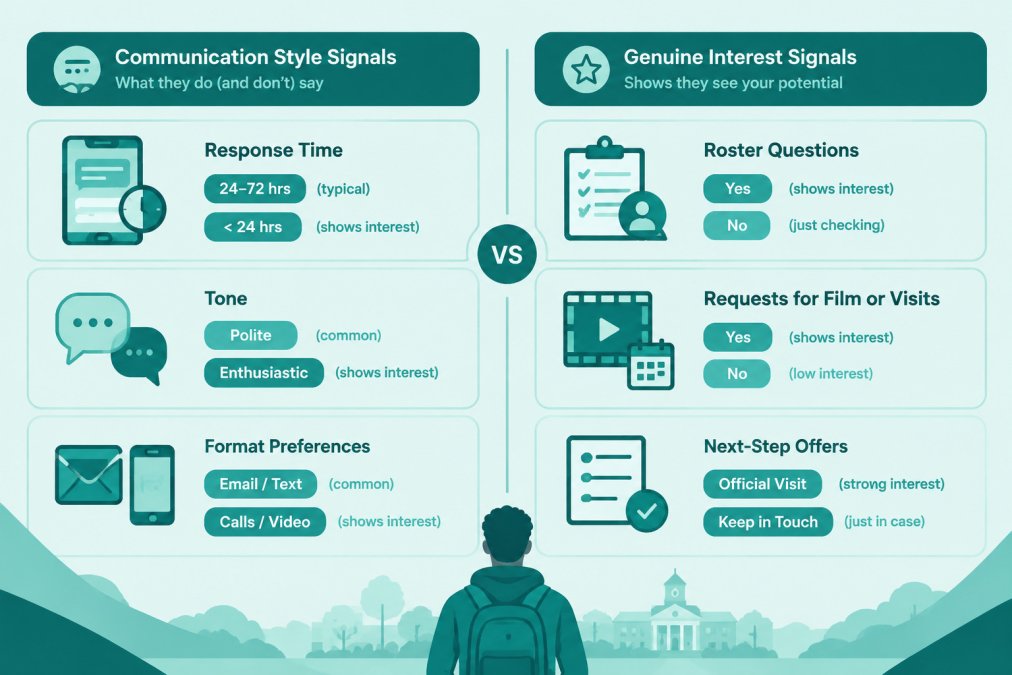
Style tells you how to talk to a coach. Interest tells you whether the coach wants you on the roster. Keep those two questions separate.
Here is a quick way to sort the signals:
- Style signals: response time, message length, tone, preferred channel, how formal they are
- Real interest signals: asks about your academics or film, requests a visit, asks for your schedule, talks about roster needs, offers a next step
A personalized request for your film can indicate interest, but routine requests don't confirm recruiting intent.
Look for patterns over time. One slow reply means very little. Extended silence may warrant a follow-up, but it does not establish why the coach hasn't responded.
Here is a simple way to check yourself: if you removed all the friendly language, would the coach still be asking you to do something next?
Step 4: Build a Simple Verification Scorecard and Respect Boundaries
A scorecard keeps your notes organized and your decisions fair, and it is the part most athletes skip.
| Factor | Category | What to Check | Score (1-5) | Evidence |
|---|---|---|---|---|
| Response time | Communication Compatibility | Replies within a few days | ||
| Preferred channel | Communication Compatibility | Which method gets answered | ||
| Tone match | Communication Compatibility | Your style matches theirs | ||
| Interest signals | Recruiting Interest | Asks for film, visit, or next step | ||
| Clarity | Communication Compatibility | Gives clear answers | ||
| Follow-through | Recruiting Interest | Does what they say they will do |
Score each factor honestly.
Add up the scores for each category separately after a few weeks. A high communication compatibility total tells you how easy a coach is to work with, and a high recruiting interest total tells you how seriously they may be considering you, but do not let a single low score in either category sink a program.
Respect boundaries while you do this, because verification is not the same as pressure. Recruiting contact rules limit when and how coaches can reach out, and they depend on your grade level and sport, so check the current contact periods for your sport before you plan outreach (NCAA Recruiting - NCAA.org).
Consent matters too. Ask a coach which channel they prefer before you text or call, and loop in a parent or guardian on calls and visits when your family is involved in the process.
Keep it consistent. Use the same message length and follow-up timing with every coach so your results are fair to compare, and review the scorecard every couple of weeks instead of every day.
Booking Your Next Coach Conversation With a Plan
You now have a way to read a coach's style, test how they respond, and separate that from real interest. The next step is turning what you learned into a plan for your next conversation.
Pick the one coach you most want to hear from. Choose the channel that got the best response. Write a short message that matches their tone. Then set a reminder to follow up in a week if you hear nothing.
RecruitMyGame is an AI-powered college recruiting platform that analyzes roster data, graduation timelines, and coaching staff stability to identify programs that may need players at your position. You can start on our free plan, and a paid trial is available separately if you want full access.
Frequently Asked Questions
What questions should you ask a college coach on the phone?
Ask questions that show you have done your homework and that help you judge fit. Good options include asking how the coach likes to be contacted, where your position fits in their recruiting plans for your class year, what academic support the program offers, and what the next step looks like if they see a fit. Avoid questions you could answer with a quick search of the team website. Write your list before the call so you do not freeze up, and jot down the answers so you can compare coaches later.
How long is a phone call with a college coach?
Calls often run a while, though some coaches keep them shorter because of a packed schedule and others talk longer when they are interested. Recruiting contact rules limit when coaches can call, so the timing and length are not always up to you. Plan for a short call, have your main points ready in the first few minutes, and let the coach set the pace. If the call runs long, that is often a good sign of engagement, but do not read too much into it on its own.
How can you tell if a college coach is genuinely interested in you?
Look for specifics. A coach who is interested will ask about your game film, your grades, your schedule, and your plans to visit campus. They may invite you to a camp, mention where you would fit on the depth chart, or follow up after your conversation without being prompted. A polite reply that thanks you for the information is not the same as interest. Keep a simple log of each exchange so you can see patterns over several weeks instead of judging from one message.
Does a coach's communication style tell you anything about recruiting interest?
Not by itself. A coach who responds slowly may be busy, not uninterested, and a coach who writes short, formal emails may simply be efficient. Style tells you how to communicate well with that person. Interest shows up in what they ask and what they offer next. Use style to decide how to reach out, and use the follow-up questions and next steps to judge whether the program is a real fit for you.