 how-to
How Should You Handle Conflicting Feedback From College Coaches?
Last Updated: November 6, 2026
Quick Summary
Conflicting feedback about college programs usually comes from people with different roles, timing, expectations, and information, so the goal is to understand why the opinions clash rather than hunting for the one right answer. Weigh firsthand sources more heavily, look for patterns across several people, and confirm details directly with the coaching staff.
- Trust patterns across several people, not a single story from one person.
- Firsthand sources like current and former players carry more weight than anonymous online posts.
- Track each coach's interactions by channel, response time, and follow-through to see the real pattern.
- Ask the coach directly about roster situation, season routine, and how they stay in touch with recruits.
- Score each program on playing opportunity, coaching stability, communication, academics, fit, and feedback consistency.
Table of Contents
- Why Feedback About a College Program So Often Contradicts Itself
- Sorting Out Who Is Giving You the Feedback
- How to Verify College Coach Communication Styles
- How to Talk to College Coaches on the Phone and What to Ask
- How to Gauge Genuine Interest From a College Coach
- Building Your Own Program Scorecard Before You Commit
- Frequently Asked Questions
Why Feedback About a College Program So Often Contradicts Itself
You ask three people about the same college program and get three different answers. One says the coach is amazing. Another says the staff is a mess. A third says it depends on who you ask. That's frustrating, but it's normal.
Feedback about college programs comes from people with different experiences, goals, and levels of knowledge, so a player who spent a season on the bench sees things differently than a starter who loved the coaching staff, and neither one is lying.
The key is not picking the "right" opinion but understanding why the opinions clash in the first place.
Most conflicting feedback comes from a few common causes:
- Different roles. A starter and a backup see the same team from opposite sides.
- Different timing. A program might have changed coaches since someone visited.
- Different expectations. One athlete wants a big-time program, another wants playing time.
- Different information. Some people talked to the coach directly, others are repeating rumors.
Sorting Out Who Is Giving You the Feedback
Before you weigh any opinion, ask one question: how does this person know what they're talking about?
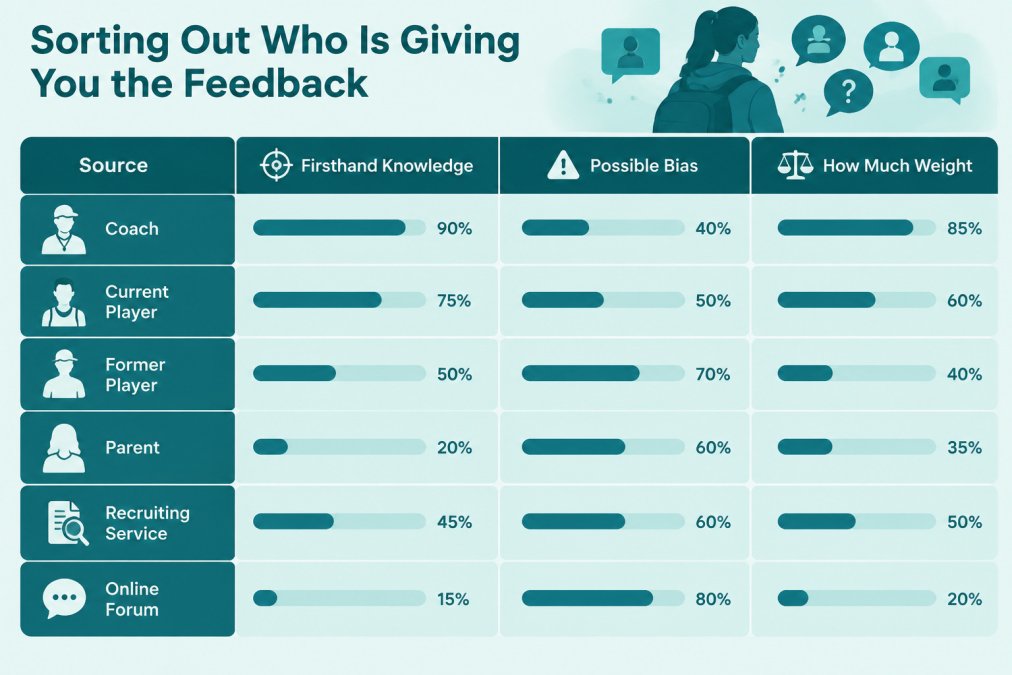
Not all sources are equal. Some have firsthand knowledge. Others are passing along secondhand stories. Some have a clear bias. Use this quick breakdown to decide how much weight to give each voice:
| Source | Firsthand Knowledge | Possible Bias | How Much Weight |
|---|---|---|---|
| Current player | High | Medium (may be frustrated or proud) | High for daily life |
| Former player | High, but older | Medium | High for past years |
| Parent of a player | Medium | Varies, can be protective | Medium |
| Recruiting service | Varies | Medium (may earn from sign-ups) | Low to medium |
| Online forum | Low | High | Low, unless it's corroborated |
A current player who just finished a rough season may have a more negative perspective. A parent might focus on one bad experience. Neither is useless, but you need to test what they say against other sources.
Here's a simple rule: trust patterns, not single stories. If five different people mention the same strength or problem, pay attention. If only one person complains about a coach, it might be a personality clash rather than a program issue. That distinction only applies to ordinary differences of opinion though: any report involving safety, harassment or misconduct should be taken seriously even if only one person has raised it.
Watch out: a review posted by someone with no name, no team, and no dates tells you very little. Look for specifics like years played, positions, and roles.
How to Verify College Coach Communication Styles
Sometimes the conflicting feedback is really about how a coach communicates: one athlete says the coach is responsive and encouraging while another says the coach goes silent for weeks. Both might be describing the same person through different channels or at different points in the recruiting calendar. Before you decide a coach is ignoring you, it helps to figure out their actual communication style instead of guessing from a single exchange. Reading through a few real examples makes it much easier to tell a busy coach from one who isn't interested.
Watch out: a slow reply is not proof of disinterest, and a fast, friendly reply is not proof of a scholarship offer. Coaches are managing travel, practice, and hundreds of recruits, so a two-week gap in March can mean the staff is in season rather than that you have been written off. The athletes who get hurt most are the ones who read a warm text as a commitment and a quiet week as a rejection. Instead of treating every message as a verdict, compare what coaches say over time and practice managing different perspectives without letting one encouraging text or quiet week define your next move.
The last piece is to adapt without pretending to be someone else. If a coach writes short, direct emails, matching that length and directness will get you further than sending long, emotional paragraphs. You should not invent a personality you do not have. The athletes who communicate most effectively are usually the ones who are clear, specific, and consistent rather than the ones who try to mirror every quirk they notice.
How to Talk to College Coaches on the Phone and What to Ask
A phone call can clear up a lot of confusing feedback. You get to hear the coach's voice, ask follow-up questions, and read the tone yourself in a way that email simply cannot deliver. The athletes who get the most out of these calls treat them like a short, prepared conversation rather than a nerve-wracking audition.
Before scheduling recruiting conversations, check the contact rules for your sport, division, and graduation year. Coaches may be restricted in when they can communicate with prospective athletes.
Walk into the call with a short list of questions ready. A few you might ask:
- What do you look for on film that stats alone do not show?
- Where do you see me fitting on the roster next season?
- What is my current status on your recruiting board?
- What would you like me to send or do before we talk again?
- What is the timeline for your remaining roster decisions?
Watch out: do not turn the call into a monologue about your stats. Avoid treating a coach's verbal encouragement as a guaranteed roster spot or scholarship. Ask what the program can formally offer, what approvals are required, and when you can expect written confirmation. Keep the call short, polite, and professional, and if you do not know the answer to something, say so and offer to follow up rather than making something up.
Want help prepping for calls like this? Super Charged Pro includes call-prep tools to help you organize your questions and track your coach conversations. Try Super Charged Pro →
How to Gauge Genuine Interest From a College Coach
Coaches talk to a lot of athletes. Knowing whether a coach is genuinely interested can save you from chasing the wrong program.
Look for these signs of real interest:
- They ask about your academics, goals, and schedule, not just your stats.
- They mention specific film or games they've watched.
- They invite you to a visit, camp, or follow-up call.
- They explain where you might fit on the roster.
Be cautious if a coach only sends form emails, avoids talking about roster spots, or never follows up. Those are not always bad signs, but they're worth noting.
Avoid treating a coach's verbal encouragement as a guaranteed roster spot or scholarship. Ask what the program can formally offer, what approvals are required, and when you can expect written confirmation. Genuine interest is a strong signal, not a guarantee.
Building Your Own Program Scorecard Before You Commit
After gathering feedback, the best move is to organize it. A simple scorecard lets you compare programs side by side using the same criteria.
Here's a basic setup you can copy:
- Playing opportunity: How many players at your position are returning or graduating?
- Coaching stability: Has the staff changed recently, and how often?
- Communication: How responsive and clear was the staff?
- Academics: Does the school fit your major and academic goals?
- Fit: Does the team culture match what you want?
- Feedback consistency: Do multiple sources agree on the program's strengths and problems?
Score each category from 1 to 5, then total them up. The number is not magic, but it helps you step back from emotion and see the bigger picture.
Update the scorecard as new information comes in. A program that looked great in the spring might look different after a coaching change in the summer.
When you're weighing competing programs, the scorecard keeps you grounded. You'll notice that the loudest opinion is not always the most useful one. Patterns, firsthand knowledge, and clear answers should carry the most weight.
Frequently Asked Questions
What should I ask a college coach on the phone?
Start with questions about the position you play and where you fit on the current roster, since that tells you how much playing time you might realistically see. Ask about the coaching staff's stability and whether any changes are expected, how the program handles academics, and what their recruiting timeline looks like for your class year. Also ask what they need to see from you before they can make a decision. If the answers to these questions line up with what you heard from other sources, you have a stronger basis for trusting that feedback. If they don't line up, write down the specific gap so you can ask about it directly.
How long is a typical phone call with a college coach?
Recruiting calls vary in length, but athletes should prepare a few priority questions.
What does it mean when a college coach wants to call me?
A call request usually means the coach has some level of interest and wants to learn more about you, but it doesn't guarantee a scholarship or a spot on the roster. Coaches may call to evaluate your fit, to answer questions you have, or simply to keep a relationship warm. Take the call seriously, be ready to talk about your goals, and pay attention to how the coach discusses your position and your future. Those details tell you more than the call itself.
How can I tell whether a college coach's communication style is a good fit for me?
Pay attention to how quickly the coach responds, which channel they prefer, and how direct they are when answering questions. Some coaches reply fast by text but are vague on details, while others write longer emails and expect thoughtful replies. Neither is wrong, but you want to know what you're signing up for. Track your interactions over a few weeks and notice whether the coach follows through on what they say they'll do. Consistency matters more than any single message.