 how-to
How to Explain a Low GPA to College Coaches
Last Updated: November 4, 2026
Quick Summary
Be upfront about it. Coaches check academics anyway, so hiding a low GPA looks worse than owning it. Explain what happened, show what you've changed, and let your film and character make the case alongside your grades.
- College coaches typically evaluate a recruit's academics, since NCAA Division I and II initial eligibility includes a minimum core-course GPA; standardized test scores are no longer required for NCAA certification, though colleges may still use them for admission or scholarships.
- A low GPA is not automatically a dealbreaker, because coaches also weigh your film, measurables, and character.
- Many athletes with modest grades still earn roster spots by showing strong effort and clear improvement.
- Keep your first message short and mention your academics in one honest sentence with a specific step you're taking.
- Send a follow-up in two weeks if you haven't heard back from the coach.
Table of Contents
- Why Coaches Ask About Your GPA (and Why It Isn't the End)
- How to Get Recruited With a Low GPA: Owning the Story
- What Coaches Actually Want to Hear
- What to Say to a College Coach and the Email Template That Works
- Frequently Asked Questions
Why Coaches Ask About Your GPA (and Why It Isn't the End)
College coaches typically evaluate a recruit's academics because eligibility and admission can determine whether an athlete can realistically join the program. For NCAA Division I and II, initial eligibility includes NCAA-approved core courses and a minimum core-course GPA; standardized test scores are no longer part of NCAA initial-eligibility certification, although individual colleges may still require them for admission or scholarships (NCAA Initial Eligibility Requirements - NCAA.org). This core-course GPA only counts NCAA-approved core courses and can differ from the overall GPA on your transcript. Division I requires a minimum 2.3 core-course GPA, Division II requires a minimum 2.2 core-course GPA, and Division III sets its own academic and admission standards. You can review those standards directly on NCAA Eligibility Center core-course requirements.
But a low GPA is not automatically a dealbreaker. Coaches also weigh your film, your measurables, and your character. Many athletes with modest grades still earn roster spots because they show strong effort and clear improvement. For a clear breakdown of how academics fit alongside film, measurables, and character, start with the guide to how college recruiting works today.
How to Get Recruited With a Low GPA: Owning the Story
Don't hide your GPA. Coaches will usually need to review your academic record as recruiting progresses, and hiding it looks worse than owning it. Instead, explain what happened and what you've changed.
Your profile should make the case for you. RecruitMyGame is built to help you organize film, academics, and coach communication in one place, so the full story is easy to review.
What Coaches Actually Want to Hear
When you bring up a low GPA, coaches respond best to three things: context, ownership, and evidence of improvement. Context explains what happened. Ownership means you don't blame a teacher or a class. Evidence of improvement shows a specific, measurable step you've already taken.
A weak explanation sounds like: "My GPA is low because I had bad teachers." A stronger one sounds like: "I struggled academically during sophomore year, particularly in math. Since then I've started tutoring twice a week and raised my semester GPA from 2.3 to 2.9."
- One bad semester: Name the term, the subject that pulled your grades down, and the specific change you made right after.
- A long-term academic struggle: Acknowledge the pattern honestly, then point to the concrete support you've put in place, such as tutoring or a new study routine.
- A GPA that's improving but still low: Lead with the upward trend and your current number, so coaches see the direction, not just the starting point.
What to Say to a College Coach and the Email Template That Works
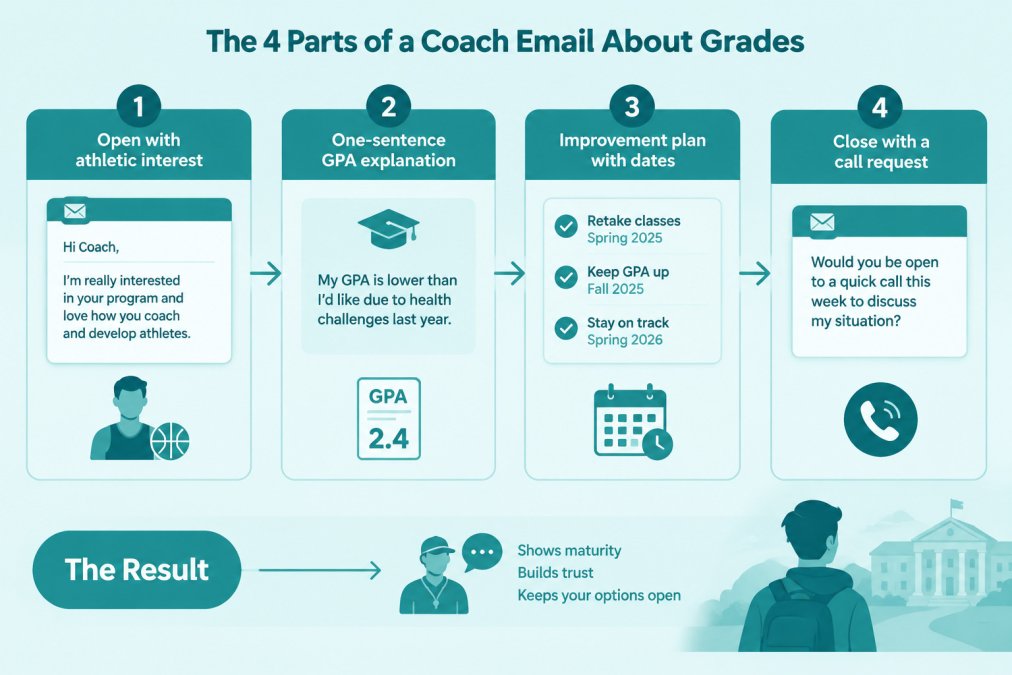
Keep your first message short and direct. Say who you are, what position you play, and why you're interested in their program. Then mention your academics in one honest sentence. If you want more detail on writing outreach DMs that get responses beyond this single template, that guide walks through several versions.
Subject: [Position] Recruit, Class of [Year], [Your Name]
Coach [Last Name],
My name is [Your Name], and I'm a [position] from [High School] in the class of [Year]. I'm very interested in [University] because of your program's focus on [something specific].
My GPA is currently [X.X], and I've been working to raise it. This term I'm [specific step, such as tutoring or a new study schedule].
I've included my recruiting profile and highlight film below, which also includes my academic information. Would you have time for a short call this month?
Thank you for your time.
[Your Name] [Phone] | [Email]
Send it, then follow up in two weeks if you haven't heard back. If you want a clear process for scouting programs, building a complete profile, and then contacting coaches, this scout-know-reach approach lays it out step by step.
Here is a quick overview of the email approach covered in this section, so you can see the steps at a glance.
| Step | What to do | Timing |
|---|---|---|
| Introduce yourself | Say who you are, your position, and your class year | First line of the email |
| Show interest | Name the school and something specific about its program | Second paragraph |
| Address academics | Give your GPA in one honest sentence and a specific step you're taking | One sentence |
| Share materials | Include your recruiting profile and highlight film, which also includes your academic information | Before you sign off |
| Ask for a call | Request a short call this month | Closing line |
| Follow up | Send a reminder if you haven't heard back | Two weeks later |
Frequently Asked Questions
Will a low GPA stop me from being recruited?
Not automatically. Athletic ability gets a coach's attention, but academics can determine whether a school is a realistic recruiting option, since coaches also have to get you admitted and keep you eligible. A low GPA can limit which schools you can realistically target, especially for NCAA Division I and II programs with core-course and GPA requirements. The good news is that coaches can often flag a prospect early, so you have time to build a stronger academic record and make your case directly.
Should I mention a low GPA in my recruiting profile?
Be upfront about it, but keep it short. Hiding your grades usually backfires once a coach looks at your transcript. Mention your GPA alongside a clear reason and a plan, like a rough semester that has since improved or a new study routine. Pair it with your strengths in the classroom, such as a rising trend or strong test scores, so coaches see the full picture.
What GPA do I need to play NCAA sports?
For NCAA initial eligibility, Division I requires a minimum 2.3 core-course GPA and Division II requires a minimum 2.2 core-course GPA. Division III does not set NCAA academic minimums and instead follows each school's own admission standards. These are eligibility minimums, not a guarantee of admission, since individual colleges can set higher academic requirements of their own.
Ready to put your full profile in front of college coaches? Try Super Charged Pro with RecruitMyGame and show your film, academics, and progress in one place.