 How-to
Navigating Athletic Scholarship Negotiations With Coaches
Last Updated: November 19, 2026
Quick Summary
Approach scholarship negotiations by treating the first offer as a starting point, not a final number, and reply with a calm thank-you, a request for the written terms, and one scheduled follow-up call. Compare offers by net cost rather than award size, and confirm current rules for your division and sport with the compliance office.
- Gather transcripts, a written budget, and every aid offer letter before any money talk.
- Keep negotiation emails under 150 words, thank the coach, and ask one clear question.
- Ask whether your sport is head-count or equivalency, since partial awards are normal in equivalency sports.
- A verbal offer is an invitation to keep talking, not a commitment you can compare.
- Division III schools do not award athletic aid but can offer academic and need-based aid.
Table of Contents
- Preparing Your Case Before Athletic Scholarship Negotiations Begin
- How to Respond to an Athletic Scholarship Offer
- Athletic Scholarship Negotiation Email Templates That Get Replies
- NCAA Scholarship Rules and Limits Every Family Should Know
- Comparing Multiple Athletic Scholarship Offers by Net Cost
- Organizing Your Negotiation With Recruit My Game
- Frequently Asked Questions
Preparing Your Case Before Athletic Scholarship Negotiations Begin
Scholarship negotiations start long before you talk money with a coach. Coaches generally respect prepared athletes, and walking into a scholarship conversation without paperwork puts you at a disadvantage.
Documents and Numbers to Gather First
Build one folder before any money talk.
- Official transcripts and current GPA
- Test scores, if available
- Highlight film and a one-page athletic resume
Our college recruiting resources include timeline checklists, scholarship question lists, and free tracker spreadsheets.
One common mistake: families treat the first offer as final. In practice, the first number is a starting point, and coaches expect a reply that shows interest and asks questions.
How to Respond to an Athletic Scholarship Offer
The best response to an athletic scholarship offer is a calm thank-you within a few days, a request for the written terms, and one scheduled follow-up call. Do not accept or decline on the spot.
Say this: "Thank you. I'm excited about this offer. Can we set up a call next week to talk through the details?"
Get the Offer in Writing Before You Compare Anything
Most verbal offers are real expressions of interest, but the binding details live in the written athletic aid agreement, often called a tender or an athletic scholarship agreement. Ask the coach or compliance office for the written document and read it before you compare schools.
When the document arrives, check these items line by line:
- Award type and amount. Is it a full or partial award, and is the amount a dollar figure or a percentage of cost?
- What it covers. Tuition and fees, room and board, books, and other costs are separate lines. A "full scholarship" in conversation may not match the written cost-of-attendance figure.
- Duration and renewal. Is the award for one year or multiple years, and on what conditions is it renewable?
Questions to Ask on the Follow-Up Call
Bring the written document to the call and ask about the parts that rarely appear in the first conversation:
- Is the award a full or partial scholarship, and is it head-count or equivalency for this sport?
- Which costs does it cover: tuition, fees, room and board, books?
- Is it renewable each year, and on what conditions?
Before you reply, read our list of questions to ask college coaches during recruiting visits. Specific questions signal a serious recruit.
What to Do If the Offer Is Verbal Only
Some coaches extend a verbal offer before any written document exists. That is normal early in recruiting, but treat a verbal offer as an invitation to keep talking, not as a commitment you can compare against a written offer from another school.
Watch out: A verbal promise that an award will "be taken care of" or "renewed as long as you perform" is not the same as a written renewal condition. Ask for the condition in the written agreement.
Athletic Scholarship Negotiation Email Templates That Get Replies
Short, specific emails get answers. Keep every message under 150 words, thank the coach, and ask one clear question.
Template 1: Acknowledging an Offer and Asking for a Follow-Up Call
Subject: Thank you for the offer, [Coach Last Name]
Dear Coach [Last Name],
Thank you for offering me a roster spot at [University].
Preparing for that call matters as much as the email. Our guide on how to prepare for a college coach phone call walks through the questions and tone coaches respond to.
Template 2: Asking About Additional Funding After a Competing Offer
Subject: Following up on scholarship details, [Full Name]
Dear Coach [Last Name],
Thank you again for the offer to join [University]. I want to be upfront: I have another offer with a stronger financial package.
[University] is still my top choice for [specific reason].
Honesty beats bluffing. Coaches talk to each other, and invented offers get found out.
NCAA Scholarship Rules and Limits Every Family Should Know
Scholarship rules are not one set of numbers. They depend on division, sport, and recruiting year, and an old forum post can be actively wrong. Because eligibility rules can shape how you present your case, connect the verified requirements to your preparation for a conversation with coaches, as WPF USA emphasizes when discussing scholarship interviews.
Division I: Head-Count vs. Equivalency Sports
Division I splits sports into two scholarship structures, and the difference changes how you should read an offer.
- Head-count sports award a set number of full scholarships. A coach either offers a full ride or no athletic aid; partial athletic awards are not the norm. Common head-count sports include football (FBS), men's and women's basketball, women's gymnastics, women's tennis, and women's volleyball. Confirm the exact list and current limits on the NCAA recruiting rules guide.
- Equivalency sports give a coach a total scholarship budget to divide across the roster, so a coach can split it into many partial awards. Most Olympic sports, baseball, softball, soccer, track and field, and wrestling fall here. A 50% offer in an equivalency sport is a normal outcome, not a slight.
In head-count sports, the practical question is binary: full or walk-on. In equivalency sports, the question is how the partial award combines with academic merit aid, need-based aid, and out-of-state tuition waivers to reach a workable net cost.
Division II, Division III, and Other Governing Bodies
Division II programs can offer athletic scholarships, and partial awards are common (Division II Athletics Scholarship - NCAA.org). Division III schools do not award athletic aid, but they can offer academic and need-based aid, and a coach can still advocate in the admissions and aid process (Student-Athlete Scholarships and Grants - NCAA.org). NAIA and NJCAA schools set their own scholarship rules; do not assume an NCAA limit applies to an NAIA or junior college offer.
Roster Limits and the House Settlement Changes
The NCAA has revised roster and scholarship limits in recent years, including changes tied to the House v. NCAA settlement that took effect for the 2025-26 academic year (DI Board of Directors formally adopts changes to roster limits - NCAA.org). Because the details vary by sport and division, treat any specific number you read online, including in this article, as something to verify against the current official rule.
What This Means for Your Negotiation
Three practical takeaways follow from the rules:
- Ask which structure applies. Ask the coach whether your sport is head-count or equivalency at that school, and whether the offer is full or partial.
- Ask how the award fits the limit. A coach cannot exceed the program's limit for that sport and year, so a low offer may reflect a full roster budget rather than a lack of interest.
- Ask what happens if rules change. Roster and scholarship limits have moved recently; ask how the program handles an award if limits shift during your eligibility.
Watch out: A coach who quotes a scholarship number without naming the division, sport, and year may be working from an outdated limit. Ask for the current figure in writing and confirm it with the compliance office.
For the wider recruiting calendar and contact rules that shape these talks, read our NCAA recruiting rules guide.
Comparing Multiple Athletic Scholarship Offers by Net Cost
Compare offers by net cost, not by the size of the scholarship. Net cost is what your family actually pays after athletic aid, academic merit aid, need-based aid, and grants are applied.
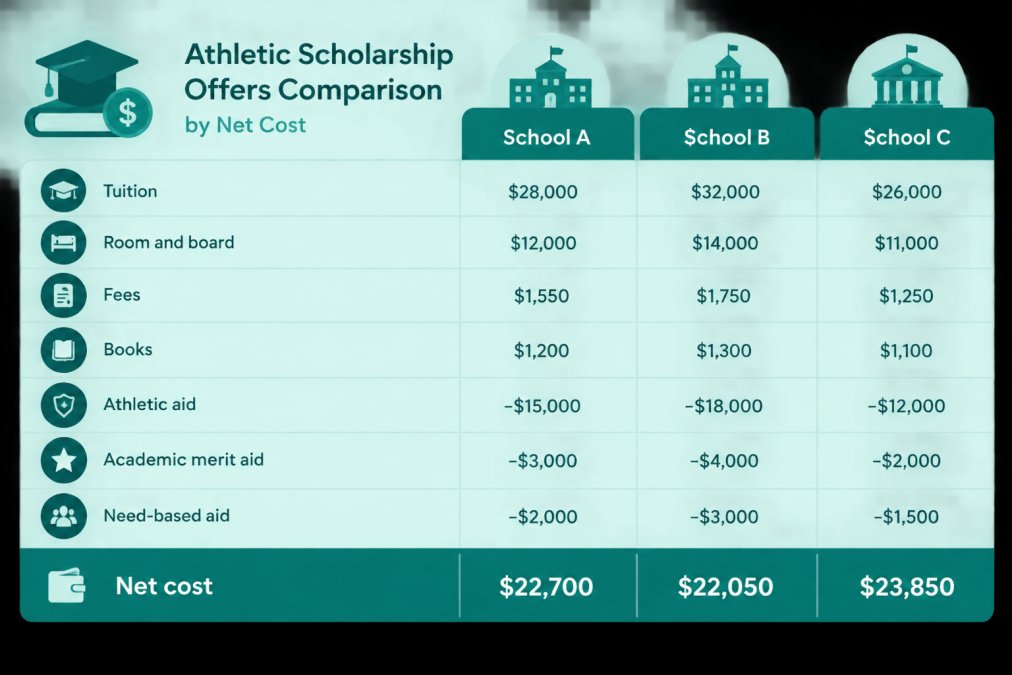
| Cost Line | School A | School B | School C |
|---|---|---|---|
| Tuition and fees | $42,000 | $28,000 | $55,000 |
| Room and board | $14,000 | $11,000 | $16,000 |
| Books and supplies | $1,200 | $1,000 | $1,400 |
| Athletic aid | $18,000 | $9,000 | $30,000 |
| Academic merit aid | $6,000 | $12,000 | $0 |
| Need-based aid | $0 | $5,000 | $0 |
| Net cost per year | $33,200 | $14,000 | $42,400 |
School C
Run this math for every offer, then weigh fit: roster need, depth chart, playing time, and coaching stability. If you already have offers, compare them by roster need, depth chart, physical fit, and coaching stability to find where you will actually see the field.
Organizing Your Negotiation With Recruit My Game
Negotiation goes better when you know which programs genuinely need your position.
You can also share a verified athlete profile through a personal web address and QR business card.
Negotiating scholarship money is uncomfortable for most families. The fix is not aggression, it is preparation: written terms, honest numbers, and questions asked early.
Frequently Asked Questions
How do you professionally initiate scholarship negotiations with a college coach?
Start by thanking the coach for the offer and expressing genuine interest in the program, then ask for a scheduled call to discuss the financial package in detail. Bring documentation: the written offer, your family's net cost calculation, and any competing offers. Ask specific questions about whether the award is renewable, what conditions affect renewal, and whether additional academic or need-based aid could stack with the athletic award. Keep the tone collaborative rather than demanding, and follow up every call with a written summary email so both sides have a record.
What is the 105 scholarship rule, and how does it affect negotiations?
The 105 scholarship rule refers to the NCAA Division I Football Bowl Subdivision team limit of 85 counters, which replaced the previous 25-per-year initial counter limit after the NCAA changed its football model. Because rules vary by division and sport, confirm the current limit for your specific situation with the school's compliance office before negotiating. Coaches work within hard team caps, so understanding the limit helps you frame requests realistically and ask whether the offer is a full or partial scholarship within that cap.
Can a coach take away an athletic scholarship after it is offered?
A verbal offer is not binding for either side. Once a student-athlete signs a written offer or National Letter of Intent, the terms depend on the school's written agreement and the governing body's rules. Athletic scholarships are typically renewed annually, and renewal can depend on factors such as roster status, conduct, and academic eligibility. Ask the coach directly about renewal conditions, request the written terms, and keep copies of every document. If a coach implies an award could be pulled, ask for the specific conditions in writing.
How should you handle multiple scholarship offers during negotiations?
Treat each offer as a complete package, not just a dollar figure. Build a comparison sheet that lists tuition, room and board, fees, books, athletic aid, academic merit aid, need-based aid, and your family's out-of-pocket net cost for each school. Then weigh fit factors: roster need at your position, coach tenure, playing time, academic programs, and graduation timelines. It is fair to tell a coach you have other offers and a decision timeline, but never invent an offer to create leverage. Ask each coach what additional funding might be available and by when.