 How-to
How Head Coach Changes Affect Scholarship Offers
Last Updated: November 15, 2026
Quick Summary
A head coach change does not automatically cancel scholarship offers, but it gives the new staff the right to reconsider them. Verbal offers are most at risk because nothing is signed. Scholarship offers backed by a signed National Letter of Intent or a written financial-aid agreement are generally more protected, depending on division and terms.
- A verbal offer is only a statement of intent and can be withdrawn by a new staff.
- A National Letter of Intent is a one-year agreement, not a four-year guarantee.
- Keep every version of your award and get written confirmation of your status.
- Contact the new staff quickly with a short introduction and your highlight film.
- Scholarship rules differ by division; Division III schools do not award athletic scholarships.
Table of Contents
- Why a Head Coach Change Puts Scholarship Offers at Risk
- Verbal Scholarship Offer vs. Written Offer: What Each One Actually Protects
- Can a Coach Revoke Your Scholarship?
- How Recruits Should Contact a New Coaching Staff
- What to Ask a New College Coach
- Rules That Differ by Sport, Division and Scholarship Model
- Your Next Step: Checking Your Offer Status This Week
- Frequently Asked Questions
Why a Head Coach Change Puts Scholarship Offers at Risk
When a head coach leaves, many scholarship offers become uncertain. A new coach may not share the old staff's view of your recruiting profile, and a new staff usually reviews the whole board from scratch. Athletes and parents often ask this question right after they hear the news.
Here is the short answer. A head coach change does not automatically cancel your offer, but it does give the new staff the right to reconsider it. The outcome depends on what kind of offer you have, the rules for your sport and division, and how the school handles its budget.
Not every program handles a coaching change the same way. Some new staffs keep the existing class intact. Others rebuild their board quickly and move recruits to the bottom of the list.
- Check how long the current head coach has been in place
- Look at whether assistant coaches have also left recently
- Watch for vacancies in the staff directory or unusual posting activity, and use a step-by-step guide to tracking college coaching staff stability to check how reliable a program's staff has been.
- Review recent program news and local coverage, and see practical ways to monitor coach turnover so you can spot a staff change early.
Verbal Scholarship Offer vs. Written Offer: What Each One Actually Protects
The phrase "I have an offer" can mean three very different things, and a coaching change exposes the difference fast. Sort your situation into one of these buckets before you make any decision.
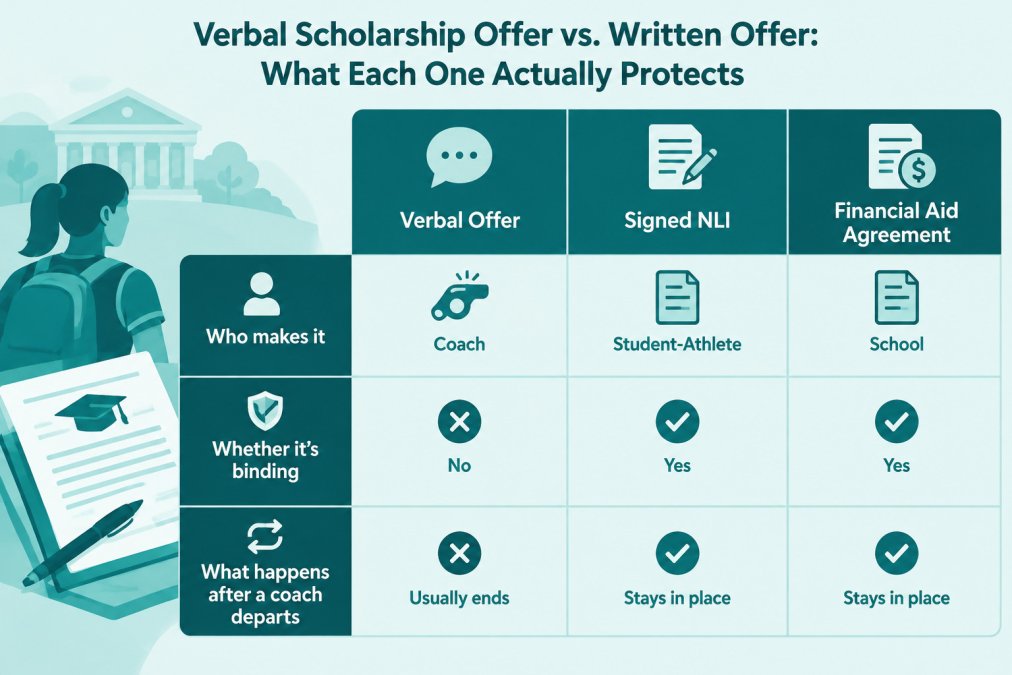
Verbal offer. A coach tells you, by phone, text, in person, or on a visit, that the program wants you and intends to offer athletic aid. Nothing is signed and nothing is filed with the school. A verbal offer is a statement of intent from one staff, not a school obligation. When that staff leaves, the verbal offer can disappear with it, and no rule is broken. This is the most common way recruits lose a spot after a coaching change.
National Letter of Intent (NLI). The NLI is an agreement administered by the NCAA that a recruit signs with a participating school. Its binding terms and any effect of a coaching change should be confirmed with the school and the NCAA.
Financial-aid agreement. This is the school's own written award document, separate from the NLI. It spells out the amount and type of aid, whether it is renewable, the conditions for renewal or reduction, and the period covered. At some schools the financial-aid agreement is the only signed document, especially where the NLI is not used. Read the renewal language closely, because that is where most of the practical risk lives.
| Document | Who signs | What it binds | Survives a head coach change? |
|---|---|---|---|
| Verbal offer | Nobody | Nothing formal | No, new staff can withdraw it |
| NLI (Division I and II) | Recruit and school | Attendance for one academic year plus the aid stated | Yes, for the period it covers |
| Financial-aid agreement | Recruit and school | The award terms the school writes | Generally yes, per its own terms |
A few practical points that trip people up:
- An NLI is a one-year agreement, not a four-year guarantee. It is renewed, or not, each year under the school's aid terms and applicable rules.
- Signing an NLI does not lock you into a coach. It locks you into a school for the covered period. If the coach leaves, you are still bound unless the school releases you or a specific rule applies.
- A financial-aid agreement can exist without an NLI, and an NLI can be paired with a separate aid agreement. Ask the compliance office which documents apply to you.
- Keep every version. Coaches sometimes describe terms verbally that never appear in the written award.
Watch out: Do not treat a screenshot of a text message or a verbal "you're taken care of" as a written offer. If it is not in a document the school has signed, assume a new staff can reconsider it.
NCAA National Letter of Intent program overview
Can a Coach Revoke Your Scholarship?
The specifics depend on your division and on the exact terms you signed, so confirm them with the school's compliance office.
A verbal offer is a different story. A new coach can drop a verbal offer at any time without violating a contract, because no contract exists. This is the most common way recruits lose a spot after a staff change.
Some situations are more complicated. Roster limits, budget cuts, or changes in your academic eligibility can all affect your aid. Read your agreement carefully and ask the school to explain in writing what would make the aid change.
Watch out: Do not assume that a signed NLI protects you from every change. Confirm the terms with the school and the NCAA compliance office before making a decision.
How Recruits Should Contact a New Coaching Staff
Once a coaching change happens, reach out to the new staff quickly and politely. Recruits who wait too long often lose ground to athletes who got in touch first.
Follow these steps to make a strong first contact:
- Find the new head coach and assistant coaches on the official athletics website.
- Send a short introduction email that names your sport, graduation year, and position.
- Attach your highlight film and a link to your academic profile.
- Ask whether the staff plans to evaluate athletes in your position.
- Follow up once after one to two weeks if you have not heard back.
Keep your messages brief. Coaches receive many emails, so lead with the most useful facts. Use the coach's preferred contact method, which you can often learn from earlier conversations or from the staff's public profiles.
What to Ask a New College Coach
Ask questions that help you understand where you stand. Write the answers down, and request written confirmation of anything important.
- Do you plan to keep the current recruiting class?
- How does the staff evaluate athletes in my position?
- Is my scholarship offer still in place, and under what conditions?
- What is the roster situation for my position over the next two years?
- What academic support does the program offer?
- When will you make decisions about remaining scholarship money?
A coach who answers these questions clearly is giving you useful information, even if the answer is not what you hoped to hear.
Rules That Differ by Sport, Division and Scholarship Model
The same coaching change can mean very different things depending on your division and whether your sport uses full scholarships or splits aid. This is the part most recruiting advice skips, and it is where recruits get surprised.
Division III. Division III schools do not award athletic scholarships (NCAA Division III Initial Eligibility Requirements - NCAA.org). They can offer academic and need-based aid, and a coaching change does not touch that aid the way it can touch an athletic award. If you are a Division III recruit, the coaching change affects your roster spot and playing time far more than your financial package.
Do not assume an NCAA rule applies to an NAIA or junior college offer. Check the governing body's current rules for your sport.
| Division | Athletic scholarships? | Typical model | What a coaching change most affects |
|---|---|---|---|
| Division I | Yes | Head-count (football, basketball) or equivalency (most others) | Full-slot allocation or partial-aid budget |
| Division II | Yes | Mostly equivalency | Partial-aid budget and roster spots |
| Division III | No | Academic and need-based aid | Roster spot and playing time, not athletic aid |
| NAIA | Yes | Own rules | Aid terms under NAIA rules |
| NJCAA | Yes | Own rules | Aid terms under NJCAA rules |
Two more variables sit on top of the division rules:
- Roster limits. Programs operate under roster limits that cap how many athletes a staff can carry. A new coach who inherits a full roster may have to make room before adding anyone, which can push a recruit's timeline back.
- Sport-specific recruiting calendars. Contact periods, dead periods, and signing windows differ by sport. A coaching change in the middle of a dead period can delay when a new staff is allowed to talk with you, so check the calendar for your sport before you expect a quick answer.
Because these rules change and are applied per sport and season, confirm your specific situation with the school's compliance office and the current rules published by your governing body rather than relying on a general summary.
NCAA division and sport scholarship rules
Your Next Step: Checking Your Offer Status This Week
Start by listing every offer you have received and noting whether it is verbal, written, or signed. Then contact each program and ask for written confirmation of your status. Use the checklist below to stay organized.
- List each school and the type of offer you have
- Confirm the head coach and assistant coaches for each program
- Ask each school to put your status in writing
- Read any signed agreement for renewal and revocation terms
- Note the deadlines for signing or accepting offers
- Keep copies of all emails and documents
If you want help keeping your recruiting contacts and coaching updates organized in one place, RecruitMyGame offers a free plan to get started, with paid options for athletes who want more tools.
Frequently Asked Questions
What happens to a scholarship offer when a head coach leaves?
A head coach departure does not automatically cancel an offer, but it changes who controls the decision. A verbal offer is generally not binding on the school, and a new staff can review the recruit's file and decide whether to honor it. A signed National Letter of Intent and a signed athletic financial aid agreement carry more weight, though the terms still depend on the school's policies, the division and the specific agreement. Ask the athletics department in writing how your status will be handled.
Can a coach revoke your scholarship?
A coach can withdraw or reduce an offer in several situations, including roster changes, budget limits, or a decision that the recruit no longer fits the program. Once a financial aid agreement is signed, the terms are generally more protected, but the rules vary by division and sport. Student-athletes who receive any notice of change should request the reason in writing and confirm what the school's obligations are under its own published policies and NCAA rules.
What should I ask a new college coach after a coaching change?
Ask whether your scholarship offer is still active, whether the staff has reviewed your film and academics, and what your roster outlook looks like for your position. Also ask whether any aid amount is changing, what the timeline is for a decision, and what they need from you next. Request that any answers be confirmed in writing, since a verbal response from a new staff member may not reflect the final decision.
How should I contact college coaches after a coaching change?
Send a short, specific email to the new head coach and the recruiting coordinator for your position. Briefly identify yourself, your graduating class, your position, and your current offer status. Attach a link to your updated film and academic information, and ask for a brief phone call or a meeting time. Follow up once after about a week if you have not heard back, and keep copies of all correspondence.