 How-to
7 Ways to Balance Merit Aid and Athletics
Last Updated: November 9, 2026
Quick Summary
Merit aid and athletics can often be combined, but the rules depend on the school, the division, and the sport. Athletic aid is awarded by the athletics department and tied to your sport, while merit aid is awarded by the college based on grades or test scores. Confirm how each school treats both in writing before you commit.
- Athletic aid is tied to your sport, while merit aid is tied to grades, test scores, or class rank.
- Ask the compliance office whether your sport is a headcount or equivalency sport.
- Compare offers by net cost: cost of attendance minus grants and scholarships you won't repay.
- Get every aid offer in writing and confirm what conditions apply for renewal.
- Division III schools do not offer athletic scholarships but can offer merit and need-based aid.
Table of Contents
- Why Merit Aid and Athletics Interact Differently
- How Athletic Scholarships Differ From Institutional Aid
- NCAA Scholarship Stacking Rules Explained
- Academic Merit Aid Requirements for Athletes
- Managing Time Between Sports and Academic Performance
- Division Differences: D1, D2, D3 and NAIA
- Building Your Aid Package Before You Sign
- Frequently Asked Questions
Why Merit Aid and Athletics Interact Differently
Merit aid and athletic scholarships are not the same thing, and many families mix them up when weighing merit aid and athletics together. Academic merit aid is money a college gives based on grades, test scores, or class rank. Athletic aid comes from the athletics department and depends on your sport and roster needs. Understanding this difference is the first step to balancing both.
Students often assume one kind of aid cancels out the other. That is not always true. Whether they can be combined depends on the school, the division, and the specific rules involved. RecruitMyGame helps athletes compare programs so they can ask the right questions early.
How Athletic Scholarships Differ From Institutional Aid
An athletic scholarship is awarded by the athletics department for your sport. Institutional aid is awarded by the college itself, usually through admissions or the financial aid office. Both can reduce your bill, but they follow different rules.
- Athletic aid: Tied to your sport, often renewed yearly, and subject to NCAA limits.
- Institutional merit aid: Tied to academics, usually based on your GPA or test scores.
- Need-based aid: Based on your family's financial information, often through the FAFSA.
Ask each school exactly how its athletic and academic awards interact. A coach may not know the full financial picture, so confirm details with the financial aid office in writing.
NCAA Scholarship Stacking Rules Explained
Scholarship stacking means combining several sources of aid to lower your cost of attendance. Stacking can include athletic aid, merit aid, need-based grants, and outside scholarships. The part most families miss is that stacking is not a free-for-all: the NCAA governs how athletic aid counts against a team's limit, and each school decides how institutional aid interacts with an athletic award.
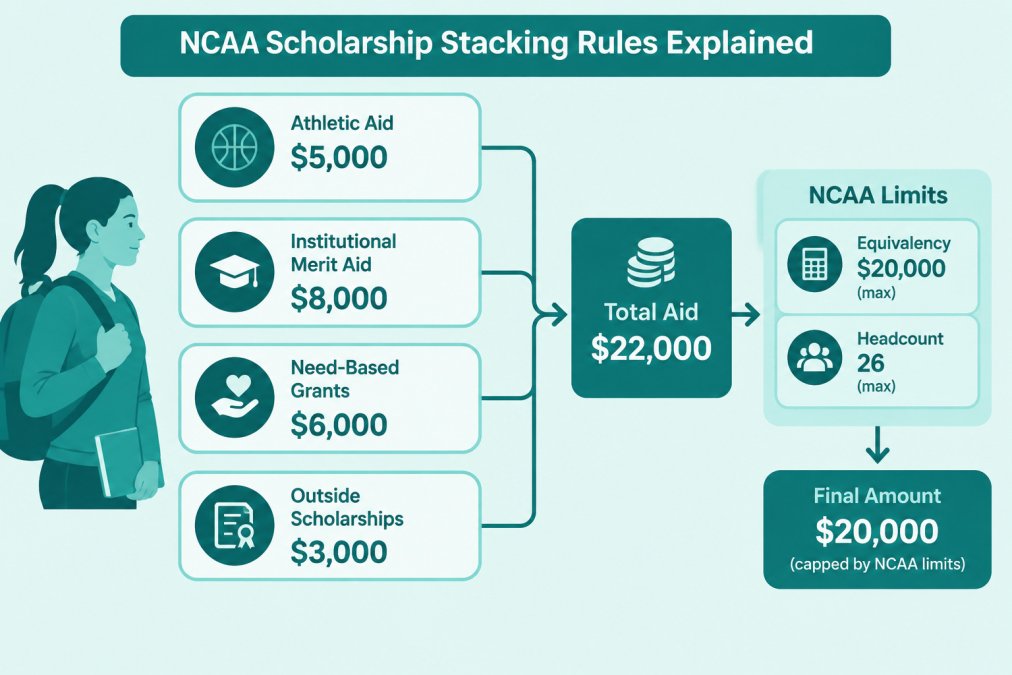
Start with the counter. Athletic scholarship limits are set by each division and sport, and the NCAA's rules on how athletic aid counts against a team's limit are published on its website. Some sports are headcount sports and others are equivalency sports, and that distinction affects whether an offer is a full award or a partial one. Ask the coach and compliance office which type your sport uses.
Then look at how institutional aid is treated. Schools package athletic aid, merit aid, and need-based aid together, and each school decides how these sources interact. The NCAA's rules on countable athletic aid set the outer boundary, but the packaging decision lives with the school, so two programs can treat an identical merit award differently. Current NCAA recruiting and financial rules explain what you can combine.
Division III schools do not award athletic scholarships, but they can award merit and need-based aid (Scholarships & Financial Aid - NCAA.org). Athletic ability cannot be a basis for that aid under Division III rules, so merit awards must rest on academic or need-based criteria.
NAIA and NJCAA schools follow their own aid rules rather than the NCAA's. If you are weighing an NAIA or junior college offer, read that association's rules directly instead of assuming they mirror the NCAA's counter and stacking framework.
Watch out: a verbal explanation from a coach that "the merit money stacks on top" is not the same as a written financial aid offer, and the financial aid office, not the coaching staff, controls the packaging.
Before you sign, ask the compliance office three questions in writing: whether your sport is headcount or equivalency, how the school treats institutional aid combined with athletic aid, and whether your athletic award counts against the team limit in your first year. NCAA scholarship and countable athletically related aid rules
Academic Merit Aid Requirements for Athletes
Merit aid usually has minimum requirements, such as a certain GPA, a test score range, or a rank in your class. Some schools also require you to keep those numbers in place each year to keep the award. Maintaining these academic benchmarks while managing a rigorous competition schedule requires a structured approach to time management, a strategy detailed further at TravelBallandmore.
- Check the minimum GPA and test score for each school.
- Find out if the award renews automatically or needs to be reapplied for.
- Ask whether athletic aid affects your eligibility for merit aid.
Keep your grades strong from your first year of high school. Many students lose merit aid because a single semester dipped below the required GPA.
Managing Time Between Sports and Academic Performance
Athletes often feel pulled in two directions. Practice, travel, and games take time away from homework and study. Schools expect you to keep your grades up, and your scholarship may depend on it.
A simple weekly plan helps. Block study time before practice, use free periods for reading, and plan big projects during lighter training weeks. Talk to your coach early if a travel schedule will conflict with an exam.
Division Differences: D1, D2, D3 and NAIA
Each division treats scholarships and financial aid differently. Division I and Division II schools can offer athletic scholarships, though the rules and limits differ. Division III schools do not offer athletic scholarships, but they can offer merit aid and need-based aid to athletes.
NAIA schools have their own rules for athletic aid and eligibility. If you are considering an NAIA program, check its rules directly rather than assuming they match the NCAA.
Because the rules vary, compare offers only within the same division's framework. Ask each school to explain its aid structure in plain terms.
Building Your Aid Package Before You Sign
Before you commit, build a full picture of what each school will actually cost you. The number that matters is net cost: total cost of attendance minus every grant and scholarship you will not have to repay. Loans are not aid in that calculation, they are a future bill.
Start with cost of attendance (COA). COA is the school's official estimate of one year's total cost, and it typically includes tuition, mandatory fees, housing, food, books and supplies, transportation, and a personal expenses allowance. COA is usually higher than tuition alone, sometimes by a wide margin, because housing, food, and travel are baked in. A scholarship described as "full tuition" covers only the tuition line; a "full ride" generally means athletic aid up to the full COA. Ask which line items each award covers.
Then subtract aid line by line:
- Athletic aid, and whether it is a full or partial award and what it covers.
- Institutional merit aid, and the GPA or test-score threshold required to keep it.
- Need-based grants, based on the FAFSA and sometimes the CSS Profile.
- Outside scholarships, and whether the school reduces other aid when you receive them.
Run the math for each school. A hypothetical example: if a school's COA is $40,000 and the package is $15,000 in athletic aid plus $10,000 in merit aid, the net cost before loans and work-study is $15,000. A second school with a $30,000 COA and $12,000 in athletic aid alone nets $18,000, a worse deal despite the lower sticker price. Label any scenario you build as hypothetical and verify every figure against the written offer.
Get the offer in writing. To compare competing offers side by side, see how to compare college athletic scholarship offers. A financial aid offer letter should list each award, its amount, and the conditions for renewal. Ask the financial aid office for a written breakdown that separates gift aid from loans and work-study.
If the package is short of what you need, you can ask for a reconsideration. Financial aid offices generally have an appeal or professional judgment process, and a polite, specific request works better than a general one. A workable script: "Thank you for the offer. After reviewing the cost of attendance and my family's expected contribution, the net cost is higher than we can manage. I have a competing offer from another program and a stronger academic record than my initial application reflected. Could you review my package for additional institutional aid?" Attach documentation, a competing written offer, updated grades, or a changed financial circumstance, and put the request in writing so there is a record.
Watch out: a coach's enthusiasm is not a commitment, and an offer that is not in writing can change before the national letter of intent or written offer stage.
Federal Student Aid, understanding your financial aid offer
The table below sums up the main elements of an aid package to compare before you commit.
| Item | What it means | Why it matters |
|---|---|---|
| Cost of attendance | School's total yearly estimate | Usually higher than tuition alone |
| Athletic aid | Awarded by the athletics department | Check whether it is full or partial |
| Institutional merit aid | Based on GPA or test scores | Confirm the threshold to keep it |
| Need-based grants | Based on FAFSA, sometimes CSS Profile | Depends on family finances |
| Outside scholarships | Awards from outside sources | Ask if the school reduces other aid |
| Net cost | Cost minus non-repayable aid | Loans are a future bill, not aid |
Frequently Asked Questions
How do I balance academics and athletics in college?
Start by treating your academic eligibility as a condition of your scholarship, not a separate goal. Most athletic departments track your GPA each term, and merit aid usually requires you to keep a minimum GPA and credit load. Build a weekly calendar that blocks study time around practice, travel and competition, and tell your academic advisor and coach about your schedule early. Athletes who meet with advisors before each registration period avoid most of the conflicts that cost them eligibility.
Can you stack athletic and academic scholarships?
Often yes, but the total is limited. Athletic and academic aid can often be combined, but the total is subject to limits set by the governing association and the school. Outside scholarships and need-based grants may also be added, subject to those limits. Ask the financial aid office for a written breakdown of how each source is counted before you accept any offer.
Does receiving academic merit aid affect my athletic scholarship?
It can. When your merit aid and athletic aid together exceed the allowable total, the school may reduce the athletic portion, a practice called scholarship displacement. The reduction is not always automatic, and schools vary in how they apply it. Confirm in writing whether your athletic award is protected from displacement before you commit, and ask how renewals are handled if your academic standing changes.
What is the difference between an athletic scholarship and merit-based aid?
An athletic scholarship is awarded by the athletic department and tied to your participation on the team. Merit-based aid comes from the university, usually based on GPA, test scores or class rank, and is not tied to a sport. The two can be combined in many cases, but each has its own renewal conditions. An athletic scholarship can be reduced or canceled for athletic reasons, while merit aid generally depends on maintaining academic standards.