 comparison
How to Compare College Athletic Scholarship Offers vs Each Other
Last Updated: November 8, 2026
Quick Summary
To learn how to compare college athletic scholarship offers, look past the headline award and check each written offer for its total annual amount, what percentage of costs it covers, and whether it renews. Then calculate your net cost at every school, since a smaller award can leave you paying less overall.
- Ask every program to put its offer in writing, because verbal promises can disappear after a coaching change.
- A school offering $12,000 against a $48,000 cost leaves you $36,000 to pay, which can beat a larger but costlier award.
- Use each school's net price calculator to estimate what you will actually pay after all grants and scholarships.
- Confirm whether each award is a one-year or multi-year agreement and what conditions allow the school to reduce it.
- Check whether athletic aid stacks with academic or need-based aid at each school before you decide.
Table of Contents
- Why Comparing Athletic Offers Is Harder Than It Looks
- Start With the Written Offer, Not the Headline Number
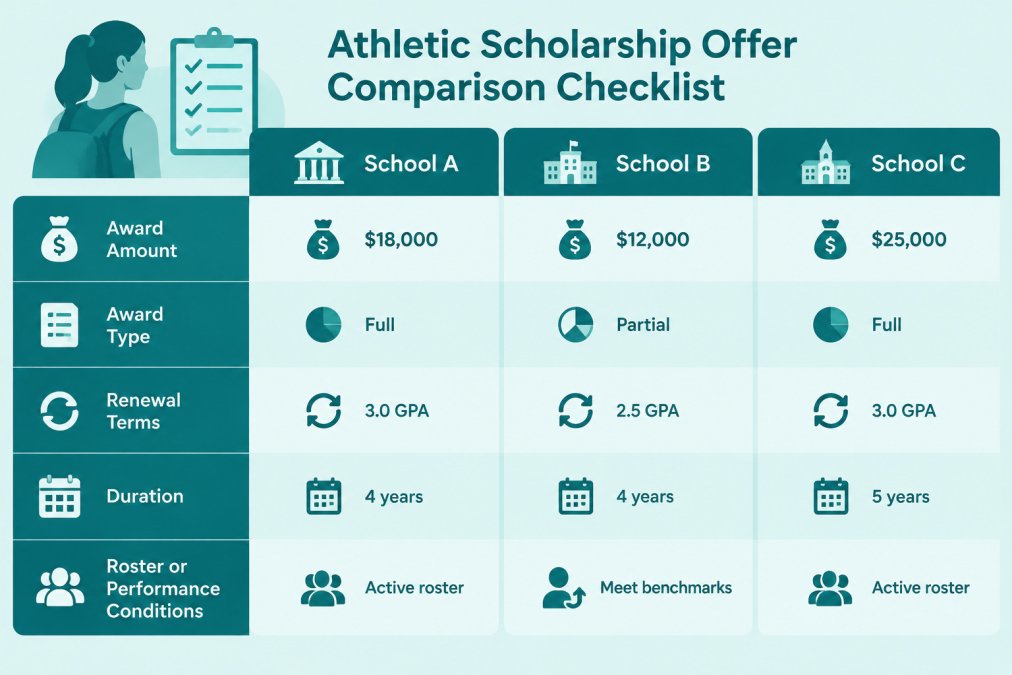
- Build an Athletic Scholarship Offer Comparison Checklist
- Partial Athletic Scholarship Examples and What They Really Cost
- Comparing Athletic Aid Against Academic and Need-Based Aid
- How to Negotiate an Athletic Scholarship Offer Without Burning Bridges
- Checking Renewal Requirements Before You Commit
- Your Next Step: Shortlisting Programs That Fit Your Offers
- Frequently Asked Questions
If you have two or three athletic scholarship offers on the table, the one with the biggest number is rarely the best deal, which is why learning how to compare college athletic scholarship offers matters so much. Families often compare offers by the headline award and miss the terms buried in the paperwork. This guide walks through a clear way to compare college athletic scholarship offers side by side, from the written letter to the cost you will actually pay.
A scholarship offer is a commitment from a school to cover part or all of your athletic costs. It is usually tied to your sport, your performance, and the team's needs for the coming year. That last part is what makes comparing offers harder than it looks.
NCAA guidance on athletics financial aid explains that most athletic aid is awarded on a year-to-year basis, which means an offer can change even after you sign. Keep that in mind as you read everything below.
Why Comparing Athletic Offers Is Harder Than It Looks
Two offers can look identical on a summary sheet and still be very different in practice. One might be a full ride on paper but split across several seasons. Another might be a partial award that covers tuition but leaves room and board unpaid.
Coaches also talk about money in different ways. A verbal promise of "we'll take care of you" is not the same as a written award amount. Schools use different terms for similar things, too. Learning to read past the wording is the first real skill in this process.
Watch out: a verbal offer can disappear after a coaching change. Get anything important in writing before you make a decision.
Start With the Written Offer, Not the Headline Number
The written offer is the document that matters. Ask every program to send its offer in writing, and read it line by line before you compare anything. Look for the award amount, the percentage of costs covered, the award period, and the conditions attached.
Pay close attention to whether the award is guaranteed for the full academic year or can be reduced. Many offers are one-year agreements that get reviewed each spring. If the letter says "subject to performance," ask what that means in plain terms.
Once you have the written offers, you can finally compare them on equal footing.
Build an Athletic Scholarship Offer Comparison Checklist
A simple checklist keeps you from comparing apples to oranges. Set up a spreadsheet with one column per school and one row per item below.
- Total annual award amount in USD
- Percentage of cost of attendance covered
- Award type: full or partial
- Award length: one year or multi-year
- Renewal conditions and review date
- Roster or performance conditions
- Whether the award covers tuition only, or also fees, books, room, and board
- Summer school or training costs included or excluded
- Coach's name and whether the staff has changed recently
Once the spreadsheet is filled in, compare each row across schools. You will often find that the offer with the smaller headline number covers more of your real costs.
Partial Athletic Scholarship Examples and What They Really Cost
Most athletes do not receive a full ride. A partial scholarship means the school covers only a share of your athletic costs, and you cover the rest. That gap is where the real comparison happens.
Take two imaginary offers. School A offers $12,000 per year toward a cost of attendance of $48,000. School B offers $18,000 per year toward a cost of attendance of $64,000. School A leaves you $36,000 to cover. School B leaves you $46,000. The larger award still leaves you paying more.
This is why net cost matters more than the award. Your net cost is the total cost of attendance minus every grant and scholarship you receive. Use each school's net price calculator, which federal rules require every college to post. The U.S. Department of Education net price calculator guidance explains how these tools work.
Watch out: a partial award may also include academic or need-based aid that is separate from the athletic money. Confirm which pieces are athletic and which are not.
The table below sums up how the two imaginary offers compare once you look past the headline award.
| School | Annual award | Cost of attendance | Amount you cover |
|---|---|---|---|
| School A | $12,000 | $48,000 | $36,000 |
| School B | $18,000 | $64,000 | $46,000 |
Comparing Athletic Aid Against Academic and Need-Based Aid
Your athletic offer rarely stands alone. Many students also receive academic scholarships, grants, or loans, and those can change the math. A school with a smaller athletic award might give you a stronger academic package that makes it cheaper overall.
Put all the aid together for each school. Our academic eligibility guide explains how the rules affect how athletic and academic money stack up. Count athletic awards, merit scholarships, need-based grants, and work-study. Subtract the total from the cost of attendance. Loans count as money you have to repay, so note them separately.
Some schools stack athletic and academic awards, and others reduce one when the other rises. Ask the financial aid office directly how the two interact at each school.
How to Negotiate an Athletic Scholarship Offer Without Burning Bridges
Negotiation is a normal part of this process, and most coaches expect a family to ask at least one question before signing, but the way you frame that question determines whether you get a real answer or a polite no.
Start by thanking the coach for the offer and confirming your genuine interest in the program, because a coach who thinks you are using their offer as leverage will stop engaging with the numbers. Once the coach has clarified what is negotiable, weigh the award against the training support you would need to thrive.
Understand what a coach can actually adjust, because asking for the wrong thing wastes your one good ask. Ask the coach about the pieces they control, such as the split of the award across terms or any added allowances. Tuition rates and the financial aid office's rules sit outside the coach's control, so leave those out of the conversation.
Avoid bluffing about offers you do not have, because coaches in the same conference and the same recruiting region talk to each other regularly, and a number that does not check out will follow you.
When the money truly cannot move, shift the conversation to the costs around the award rather than the award itself.
Watch out: never accept a verbal promise of more money later in the season without getting the revised terms in writing, because a coach who leaves or a roster that fills up can erase an informal commitment overnight.
Checking Renewal Requirements Before You Commit
A scholarship that looks generous in year one can quietly shrink in year two, and the renewal language buried in the award letter is where that change actually happens. Most athletic aid is awarded on a one-year basis and reviewed each spring, and depending on the school, the division, and the specific offer, the coach and the athletic department may choose to renew, increase, reduce, or discontinue the award for the following year.
Ask every program to state in writing whether the award is a one-year agreement or a multi-year agreement, because the two behave very differently. A one-year award is renewed at the school's discretion each spring, and while many coaches renew every athlete on the roster as a matter of practice, the letter itself may not obligate them to do so. A multi-year agreement commits the school to a defined award across two or more academic years, which gives you far more stability, but even a multi-year agreement usually contains conditions that allow the school to reduce or cancel the aid if you fail to meet them, so read the conditions rather than assuming the length of the agreement protects you.
Injury is a question families often forget to ask. Ask the coach and the compliance office directly what happens to your award if you suffer a season-ending injury, because the answer depends on the specific terms of the letter and on the school's own policy rather than on a single universal rule. Offer terms on injury vary, so get the specifics in writing.
Academic requirements are the other renewal trigger that catches families off guard. Athletic aid can be tied to academic requirements, so an athlete who falls below a school's required credit load or GPA may lose aid.
Roster and coaching changes deserve their own line of questioning, because a coaching change is one of the most common reasons an award gets renegotiated or reduced. Ask how long the current staff has been in place, whether the position coach who recruited you is still on staff, and what the school's practice has been when a new coach inherits a roster.
Watch out: treat any promise longer than one year as a strong signal rather than a guarantee, and confirm that the multi-year language actually appears in the written award letter before you count on it.
Your Next Step: Shortlisting Programs That Fit Your Offers
Once you have written offers and a completed comparison sheet, narrow your list to the two or three schools that fit your sport, your academic goals, and your budget. You can also find other scholarship opportunities to build out that shortlist. An offer only helps if you can realistically compete at that level and afford the school after aid.
If you are still building your list, RecruitMyGame can help you find programs with roster needs at your position. The platform uses roster data, graduation timelines, and coaching staff stability to show where your skills may be wanted. You can get started for free to start shortlisting, then bring your written offers back to the spreadsheet you built here.
Frequently Asked Questions
Can you negotiate an athletic scholarship offer?
Often, yes, though it depends on the program and your sport. Coaches usually have a fixed scholarship budget, so the room to move is often in how the money is split, such as whether a partial offer can be bumped up or whether the school can add a need-based or academic award on top. Ask politely, get any changes in writing, and keep the tone focused on wanting to be there rather than on playing offers against each other. Coaches respect athletes who ask clear, specific questions.
Does a Division I offer mean a full ride?
Not necessarily. A Division I offer can be full or partial, and many D1 athletes receive partial awards. Some sports divide their scholarship money among a large roster, which means a coach may offer a percentage of a full ride. Always read the offer to see the exact dollar amount or percentage, the length of the award, and whether it covers tuition, housing, meals, and books. The division alone doesn't tell you what you'll pay.
What questions should you ask a coach before accepting an offer?
Ask whether the offer is a one-year agreement and how renewal is decided. Ask what happens if you get injured, and whether the award can be reduced or canceled for performance, roster changes, or academic issues. Ask how the award is split across the team and whether it can increase or decrease. Get the answers in writing before you sign anything.