 how-to
How to Spot Authentic College Program Testimonials
Last Updated: November 4, 2026
Quick Summary
To spot authentic college program testimonials, first check where the quote came from, since a verified athlete profile carries more weight than anonymous praise on a program's own site or social media. Then test the reviewer's claims against official records like the public roster, the coaching timeline, and the school's athletics department. Weigh the significance of each discrepancy rather than counting failed checks: a serious contradiction on its own can warrant real concern, while missing information alone may have an innocent explanation and call for more verification, not automatic distrust.
- Favor testimonials with a first name, graduation year, and position that you can verify.
- Check the program's current and archived rosters for the season the reviewer claims to have attended, since former athletes, transfers, and graduates won't appear on a current roster.
- Check that the review dates line up with the coach's tenure at the school.
- Weigh how serious each discrepancy is rather than counting failed checks, since missing information alone may have an innocent explanation.
- Ask current athletes direct questions about academics, playing time, and injury support.
Table of Contents
- Start With Where the Testimonial Lives
- Cross-Check Testimonials Against Official Program Data
- Ask Current Athletes the Questions That Matter, Then Reach Out to Coaches
- Frequently Asked Questions
Start With Where the Testimonial Lives
Some families may take positive testimonials at face value. Before you trust a single quote about a college program, figure out where it came from. A program's own website, a paid review site, and a verified athlete profile all carry very different weight. If you want to see how legitimate recruiting profiles are put together, check out free recruiting resources covering outreach, scholarships, and profile setup. Look for a first name, a graduation year, and a position, since a testimonial from a current athlete who can be contacted is worth more than an anonymous quote, and verified reviews on a recruiting profile tend to be more trustworthy than free-floating praise on social media. To see how verified coach reviews differ from unverified praise and why staffs trust them, read up on how they prove coachability and work ethic. Note that a college program testimonial, where an athlete describes their own experience at a school, is different from an RMG verified coach review, where a coach evaluates an individual athlete's skill and coachability: one does not verify the other. Watch for praise that sounds the same across several reviews, vague comments with no details, and quotes that only talk about winning and never about academics or coaching.
Cross-Check Testimonials Against Official Program Data
A testimonial is only as good as the facts behind it. Once you find one of the college program testimonials you're weighing, test its claims against official information, starting with the program's roster pages. Search both the current roster and archived rosters for the season or seasons the athlete claims to have attended, since former athletes, transfers, graduates, and past-season players won't appear on a current roster. If you still can't find them, seek additional confirmation rather than assuming the testimonial is fabricated. If you're still wondering how dependable these reviews really are, this deeper guide on whether college coach reviews can be trusted walks through the common pitfalls. Next, check the timeline. If a reviewer says they played for a coach from 2018 to 2021, you should check when that coach was on staff, because coaching staffs change often and a review that predates a major shift may no longer reflect the program today. You can also check the school's own athletics website, its current schedules and rosters, and the applicable athletic association's membership directory to confirm a program is active and legitimate. When weighing a testimonial, check whether:
- The reviewer appears on the current or archived roster
- The dates line up with coaching tenure
- The school confirms the program's current status
- The claims match what the athletics site publishes
Weigh the significance of each discrepancy rather than counting failed checks: a serious contradiction on its own can warrant real concern, while missing information alone may have an innocent explanation and call for more verification. You can also see how college coaches search and evaluate verified athlete profiles to compare what a coach actually looks at.
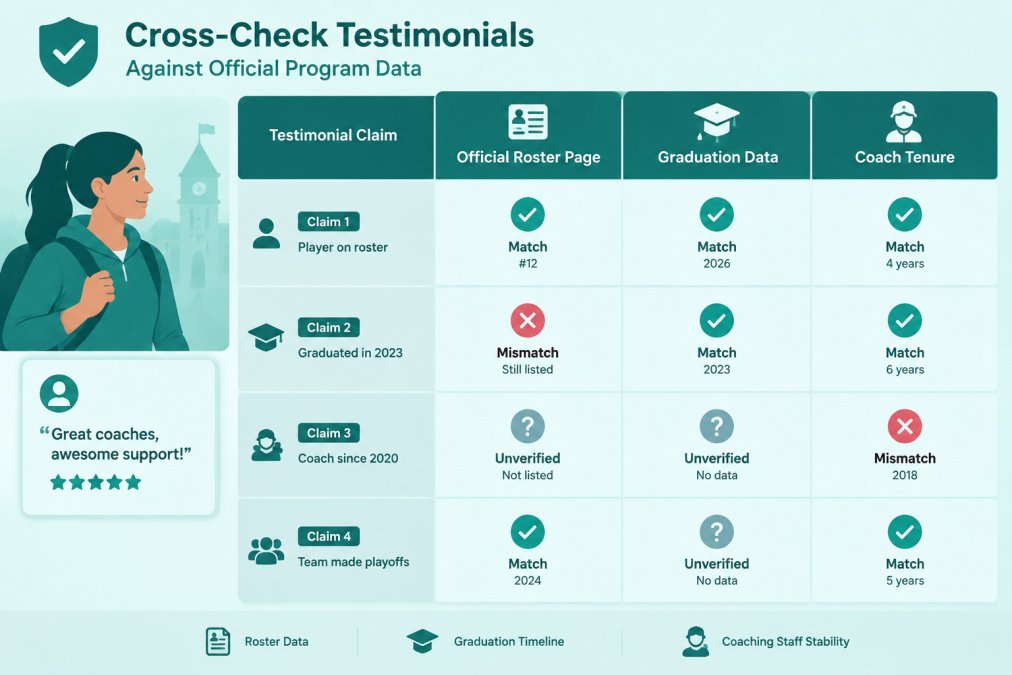
Before you trust a testimonial, run its claims through these checks against official records.
| Check | What to look for | Red flag |
|---|---|---|
| Roster search | Reviewer appears on the current or archived roster for the season claimed | Reviewer cannot be found after checking both |
| Coaching timeline | Review dates line up with the coach's tenure | Review predates a major staff change |
| School athletics department | Confirms the program's current status | Program status is unclear or inactive |
| Athletic association directory | Program appears in the applicable athletic association's membership directory | Program cannot be found in official resources |
| Published claims | Matches what the athletics site publishes | Claims conflict with official information |
| Discrepancies | Weigh how serious each one is | A serious contradiction on its own, more than a missing detail, warrants real concern |
Ask Current Athletes the Questions That Matter, Then Reach Out to Coaches
Current athletes can provide valuable firsthand perspectives on daily life in a program, so ask them direct questions that a sales pitch would never answer, like how much time you spend on academics versus athletics, whether the coach keeps promises about playing time, and what happens when someone gets hurt. Ask how often the coaching staff communicates with players, whether recruiting promises matched what you actually experienced, what you would change about the program, and how much support you get from academic advisors. Once you've heard from athletes, reach out to coaches directly with a message that stays short, specific, and respectful, mentioning your position, your graduation year, and one or two questions you'd like answered. A clear response can help you evaluate the coach's communication style. Trust the pattern you see across these conversations more than any single glowing review, because authentic programs tend to hold up under direct questions. Comparing consistent answers across athletes and coaches is also a useful habit for avoiding fake reviews, since credible accounts tend to withstand the same careful questions.
Frequently Asked Questions
How can you tell if a college program testimonial is biased?
Look at who wrote it and why. A testimonial with no specifics at all is worth a closer look, though a positive-only account can still be genuine: a lack of detail alone isn't proof of bias. Check whether the writer has a link to the program, like a recruiting service fee, a sponsorship, or a school-run account. If every review sounds like it came from the same marketing playbook, treat it as promotion, not proof.
What are the red flags of fake college program reviews?
Watch for reviews posted in bursts, reviews with generic names or no profile history, and reviews that use the same phrases as the school's own website. Be cautious of testimonials that cannot name a position, a season, or a coach. Mismatched details matter too: if a reviewer says they played for a coach who left years ago, check the dates. Fabricated reviews can still include convincing specific details, so the presence or absence of specifics about academics, housing, or money isn't a reliable test on its own.
How do I verify the experiences of current players in a college program?
Start by finding current players through the team's public roster, then reach out respectfully through school email or public social accounts that clearly belong to them. Keep any contact appropriate and public, and don't pressure athletes into sharing personal information or private team details. Ask specific questions about playing time, coach communication, and how the program handles injuries. Compare what several players say. Consistent accounts from several athletes may provide stronger evidence, although they should still be evaluated critically.