 how-to
How to Research College Team Culture Before You Commit
Last Updated: November 2, 2026
Quick Summary
To research college team culture before you commit, look past the depth chart and check coaching stability, talk to current athletes, use a campus visit checklist, and get specific answers in writing. Culture shapes how your four years actually feel, so it deserves the same scrutiny as playing time.
- Check how long the head coach and key assistants have been in place, since frequent turnover signals instability.
- Message current players at your position with a short, specific request for a 10-minute conversation.
- Watch a practice, note how coaches handle mistakes, and see whether athletes seem relaxed or tense.
- Ask compliance about the school's policy on releases and scholarships before you sign an NLI.
- Keep written notes from every program so you can compare them side by side when deciding.
Table of Contents
- Why Team Culture Matters More Than the Depth Chart
- Start With Coach Turnover and Staff Stability
- Ask Current Athletes the Questions Coaches Won't Answer
- Use a College Team Visit Checklist on Campus
- Pin Down the Questions to Ask College Coaches Before Committing
- Your Next Step: Building Your Shortlist This Week
- Frequently Asked Questions
Why Team Culture Matters More Than the Depth Chart
Most athletes pick a school based on the roster, the facilities, or the coach who recruited them. That makes sense on paper.
Team culture is the everyday reality of the program.
A common mistake is treating a strong depth chart as proof that a program is a good fit. A team can have room for you on paper and still have a culture that wears people down.
So before you commit, ask yourself what you need to feel supported, challenged, and safe. If you already have offers, you can compare them by roster need, depth chart, and coaching stability to see where you'll actually get on the field.
Start With Coach Turnover and Staff Stability
Coaching changes are one of the biggest culture shifts an athlete can face.
Look at how long the head coach and key assistants have been in place. Our guide on how coaching changes actually hit recruits lays out what to watch for.
Verifying staff stability takes a little detective work. Our practical steps for checking whether a coaching staff is actually stable make this easier.
Watch out: a coach who just got hired is not automatically a red flag. New hires can be exciting.
Ask Current Athletes the Questions Coaches Won't Answer
Coaches are great at selling the program, but current players can often tell you more about what team culture is actually like, since they have less reason to put on a show.
Start with the roster on the program's official athletic site, which lists every athlete by position and class year. Then use our ready-made list of questions to ask current players so your first conversations stay focused on what a coach is really like day to day.
Here's a template you can adapt, and it works because it's specific and gives the athlete an easy out:
"Hi [Name], I'm a [position] in the [grad year] class and I'm researching the program. Would you have 10 minutes sometime this week to talk about your experience with the coaching staff and the team culture? No pressure if you're busy, and I appreciate anything you can share."
If they say yes, come with questions that are concrete enough to produce real answers instead of polite filler.
Listen to what they don't say, too. If someone hesitates, gives a vague answer, or steers the conversation back to the facilities, pay attention to that pause, because the silence around a topic often tells you more than the words.
Write down what you hear while it's fresh, and compare notes across programs, because the pattern across three or four conversations will tell you more than any single glowing review ever could.
Use a College Team Visit Checklist on Campus
An official visit gives you a chance to see college team culture up close. Don't just follow the tour. Look for details that reveal how the team actually operates.
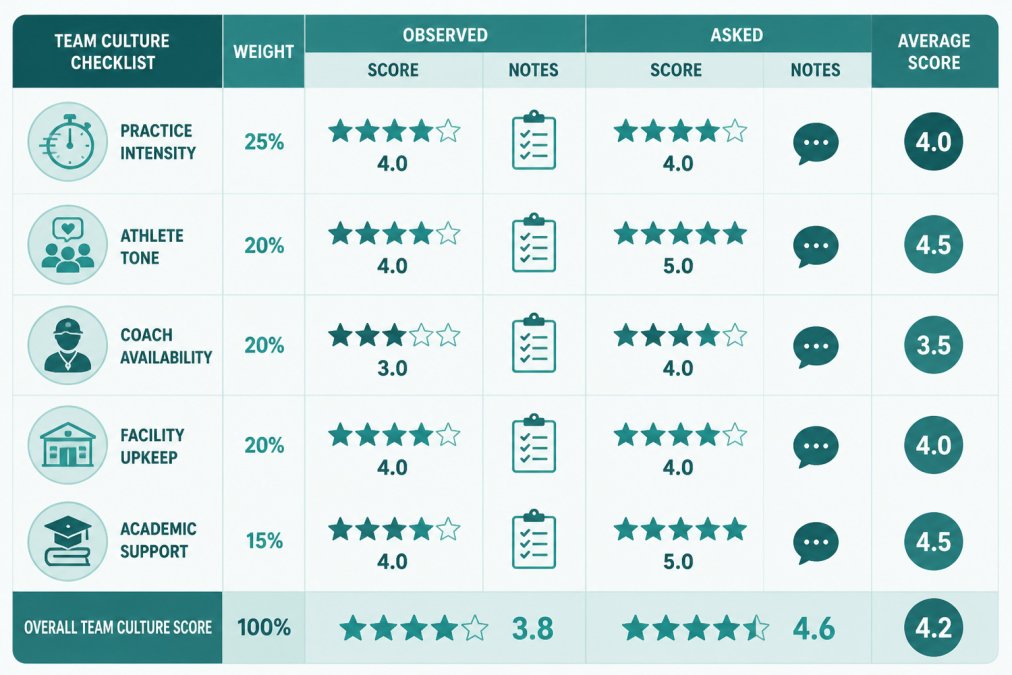
Use this checklist while you're on campus:
- Watch a practice if you're allowed, and note the energy level
- Observe how coaches talk to players when something goes wrong
- See whether athletes seem relaxed or tense around staff
- Check the condition of the facilities you'll use every day
- Ask about academic support, tutoring, and study hall availability
- Find out how travel, meals, and training schedules are handled
- Talk to a few players without coaches around
The score matrix below can help you compare programs side by side.
Write down what you observe and what you asked. Your notes will matter later when you're comparing offers.
Here's a quick checklist of what to watch for and ask about on an official visit.
| What to Check | What to Look For | Why It Matters |
|---|---|---|
| Practice energy | Relaxed or tense athletes | Shows the everyday culture |
| Coach reactions | How mistakes are handled | Reveals how staff treat players |
| Facilities | Condition of daily-use spaces | Affects your routine every day |
| Academic support | Tutoring and study hall access | Matters for balancing school and sport |
| Schedules | Travel, meals, and training timing | Shows how much time you'll have to breathe |
| Player conversations | Talk with players without coaches | Gives the most candid view |
Pin Down the Questions to Ask College Coaches Before Committing
Coaches expect questions, and asking the right ones shows you're serious while helping you get real answers instead of polished sales pitches. If you want the complete set, check out the full official visit question playbook.
Here's something to keep in mind: a signed NLI is a commitment to that school, and the coach who recruited you is not the one holding it.
Focus your questions on four areas: playing time, development, staff stability, and what happens to your scholarship and roster spot if the staff turns over. Ask specifically whether the school has a written policy for honoring scholarships during a head coaching change, and ask the compliance office, not just the recruiting coach, because compliance staff are the ones who actually administer the paperwork.
Here's what to ask, and why each question matters:
- Where do you see me fitting into the depth chart in my first year, and what happens to that plan if a new coach brings in his own recruits at my position? This forces the staff to talk about roster math instead of vague reassurance.
- What does player development look like for my position, and who specifically runs those sessions? You want a name and a schedule, not a philosophy statement.
- How long do you plan to stay at this program, and how many assistants have left in the last two seasons? Coaches won't love this one, but the answer tells you whether the staff is stable or a revolving door.
- What happens to my scholarship if the coaching staff changes? Get this in writing if you can, and ask whether the school has ever revoked or reduced a scholarship after a staff transition.
- How do you support athletes who are struggling academically or mentally, and who is the point of contact for that? A real answer includes a name, an office, and a process.
If you want to go a step further, ask the compliance office for the school's policy on NLI releases and scholarship renewals, because those two documents tell you more about your actual risk than any conversation with a coach ever will.
Your Next Step: Building Your Shortlist This Week
You now have a clear process. Start with coach stability, talk to current athletes, use the visit checklist, and press coaches for specifics. Doing all of this takes time, so keep your notes organized in one place.
This is where RecruitMyGame can help. Our platform looks at roster needs, graduation timelines, and coaching staff stability for your position, so you can focus on programs that actually have room for you.
Try Super Charged Pro to start building your list today.
Frequently Asked Questions
How can I find out what a college team is really like?
Talk to people who are inside the program right now. Current players, not just the recruiting staff, will tell you how practices feel, how coaches treat younger athletes, and whether the team sticks together off the field. Reach out through the coach or a recruiting coordinator and ask for a short call with one or two athletes at your position. Then compare what they say with what you see on a visit. If the stories line up, you're probably getting an accurate picture. If they don't, dig deeper before you decide.
What questions should I ask current college athletes about team culture?
Ask about the things a coach won't brag about. Find out how the team handles a bad loss, whether upperclassmen help freshmen with academics, and how playing time is decided when the depth chart is unclear. Ask what they'd change about the program if they could. Also ask how often coaches have changed since they arrived and how the team handled it. Listen closely to how long they pause before answering. A quick, enthusiastic answer usually means something different than a careful one.
How do I evaluate a college coach before committing?
Start with how long the head coach and your position coach have been in place. Frequent turnover often signals a program where players get lost in transitions. Look up recent recruiting classes and see whether the coach has kept commitments to players who were promised a role. Ask the coach directly how they plan to develop your position group and what happens to your scholarship if the staff changes. A coach who answers clearly and in detail is usually one who has thought it through.
What should I look for during a college team visit?
Pay attention to the small stuff. Watch how coaches talk to players when they make mistakes, whether athletes seem relaxed around the staff, and how the locker room and training areas are kept up. Sit in on a meal or walk the campus with a player instead of only the staff host. Take notes right after each conversation, because the details fade fast when you're juggling several schools. Bring your checklist so you cover the same questions at every program you visit.