 how-to
How to Build Relationships With College Athletic Scouts
Last Updated: November 2, 2026
Quick Summary
To build relationships with college athletic scouts, first confirm who you're dealing with, since scouts can refer you but usually can't offer a spot. Then send short, specific emails with your film and key stats, follow up with new information about every two to three weeks, and keep a contact log so you know who is due a message.
- Check the school's website and use a school email domain to confirm a real coach or staff member.
- Never pay anyone to be recruited, since college coaches don't charge athletes to be discovered.
- Keep cold emails under 150 words, with a film link that needs no login.
- Personalize every email with a specific detail about the program's scheme or recent season.
- Follow up about two weeks later with new film or an updated stat, not a bare check-in.
Table of Contents
- Know Who You're Talking To: Scouts, Coaches, and Recruiters
- How to Email College Coaches So They Actually Reply
- Questions to Ask College Coaches Without Sounding Scripted
- How Often to Contact College Coaches (and What a Good Follow-Up Timeline Looks Like)
- Your Next Step: Set Up Your Outreach Plan This Week
- Frequently Asked Questions
Know Who You're Talking To: Scouts, Coaches, and Recruiters
Start here, because not everyone who reaches out to you works the same way.
A college coach works for the school. They have the final say on who joins the team and who gets a scholarship offer.
A college athletic scout is different. Scouts often work for the program, or sometimes for outside evaluation groups.
Recruiters are the broadest category. Some are legitimate staff members. Others are paid services. Some are scams.
Here's how to tell them apart:
- Check the school's website. Real coaches and staff usually appear on the official athletics site with a school email address.
- Watch the email domain. A message from a free address like Gmail or Yahoo, asking for a fee, is a red flag.
- Ask the NCAA. The NCAA publishes rules on who can contact recruits and when (NCAA Recruiting - NCAA.org). Its official site, ncaa.org, is the place to confirm what's allowed.
How to Email College Coaches So They Actually Reply
Coaches get a lot of email, and most of it gets skimmed on a phone between practice and a staff meeting, so your message has to earn a second look in about three seconds. You can find college coach outreach examples and checklists that show what a strong message looks like. Your outreach needs to stand out from what college athletic scouts and coaches see all day. The athletes who get replies are not necessarily the most talented ones in the inbox, they are the ones who make it easy for a coach to say yes to a quick conversation.
Open the body with three things in the first two sentences:
- Your name, graduating class, and position
- Your height, weight, and one or two key stats
- Why you are writing to this program specifically
That last part matters most, and it is where most athletes lose the coach.
Here is a simple template you can adapt:
Subject: 2027 [Position], [Height/Weight], [Film Link]
Coach [Last Name],
My name is [Your Name], a [Position] from [High School], class of [Year]. I'm [Height] and [Weight], with a [Key Stat] in [Season].
I'm interested in [Program] because of [specific detail about their program]. My film is here: [Link]. My GPA is [GPA] and my test scores are [Scores].
Thank you for your time. I'd welcome the chance to talk about whether I might fit your roster.
[Your Name] [Phone] | [Email]
Keep the whole thing under 150 words, because long emails get ignored and a coach who has to scroll is a coach who has already moved on.
Watch out: Don't send the same mass email to 40 programs.
A common pattern among recruits who get consistent replies is to send a short follow-up about two weeks after the first email if there is no response, and to include a new piece of information, fresh film, an updated stat, a recent award, rather than a bare "just checking in." That gives the coach a reason to open the message again instead of archiving it on sight.
Before you hit send, compare how the key parts of a cold email differ so you know which details to lead with.
| Email element | What to include | Why it matters |
|---|---|---|
| Subject line | Position, class year, height and weight, film link | Coaches scan this first |
| Opening sentences | Name, class, position, key stats | Gets read in about three seconds |
| Program detail | A specific reference to their scheme or recent season | Shows you did your homework |
| Film | A link with no login, three to five minutes long | Lets coaches watch without friction |
| Total length | Under 150 words | Long emails get ignored |
| Follow-up | New film, updated stat or award after about two weeks | Gives a reason to reopen the email |
Questions to Ask College Coaches Without Sounding Scripted
Once a coach responds, the conversation gets real. Your questions show how seriously you're thinking about the fit.
Skip the questions you could answer with a quick search, like "What's your school's ranking?" Ask things that show you want to understand the program: verified coach reviews and branding can help you stand out when a coach is evaluating you.
- What does a typical week look like for players in my position?
- How do you develop players who aren't starters yet?
- What do you look for in a player beyond athletic ability?
Notice the pattern. Each question invites a real answer and opens a second question.
Don't read these off a card. Pick two or three that fit the moment and let the conversation flow from there. A coach who's talked to hundreds of recruits can spot a script in seconds.
How Often to Contact College Coaches (and What a Good Follow-Up Timeline Looks Like)
Timing is where most athletes go wrong, and it is also where the rules matter more than most recruits realize, since writing too little makes you vanish from the coach's board while writing too much makes you look desperate or, worse, runs you into a contact rule you did not know existed.
Start with the calendar, because it shapes everything else. The NCAA sets recruiting calendars by sport and division, and those calendars define contact periods, evaluation periods, quiet periods, and dead periods (NCAA Recruiting - NCAA.org).
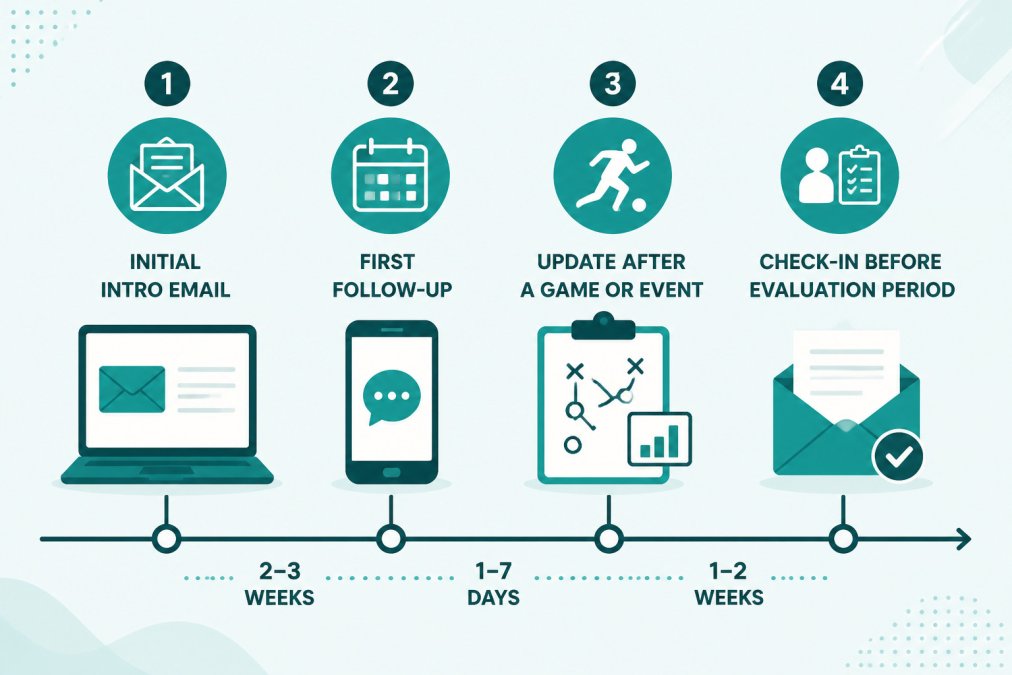
With the calendar in hand, a workable rhythm looks like this:
- Initial email: Send it once you have your film and key stats ready, ideally during or just before an evaluation period when coaches are actively building their boards.
- First follow-up: Wait 2 to 3 weeks if you have not heard back, and include a new piece of information rather than a bare check-in.
- Update after a big moment: Send a short note after a strong game, a tournament, or a new achievement, and include a link to new film so the coach has a reason to click.
- Check-in before evaluation periods: Reach out ahead of the times coaches are most likely to evaluate recruits, since that is when your name needs to be fresh in their mind.
Keep follow-ups short. Two or three sentences work fine: "Hi Coach, wanted to share my film from last weekend's tournament.
A simple contact log makes all of this manageable and is the piece most recruits skip, so keep a spreadsheet with columns for the program, the coach's name and role, the date of your last message, the date of their last response, the next step, and any notes from the conversation, and review it once a week so you know who is overdue for a follow-up and who has gone quiet long enough to deprioritize.
The athletes who build the strongest relationships are not the ones who send the most emails; they are the ones who send the right email at the right time, keep a record of every conversation, and know when to move on. Treat outreach like a season-long project rather than a one-time push, and the relationships will follow.
Your Next Step: Set Up Your Outreach Plan This Week
Reading about recruiting is the easy part. Acting on it is what moves the needle.
Pick five programs where you'd genuinely fit. Find the position coach for each one. Draft your initial email using the template above, then send it.
RecruitMyGame can help you get organized.
Start today. Before you reach out, you can organize your film, stats, and coach reviews in one profile.
Frequently Asked Questions
How do I build a relationship with a college athletic scout?
Start by figuring out who actually evaluates recruits at each program. Scouts, assistant coaches, and head coaches play different roles, and you want to know which one to contact. Send a short, specific introduction that names the program, your position, your grad year, and one thing you noticed about their team. Then keep your updates relevant. Share new game film, a stronger test score, or a meaningful result instead of sending the same message every week. Coaches remember athletes who are organized, honest about their abilities, and easy to talk to. Consistency over several months does more than one perfect email.
What are good questions to ask college coaches?
Good questions show you've done your homework and care about fit. Ask what the team needs at your position for the next recruiting class, how players are developed in their first year, and what academic support looks like for student-athletes. You can also ask how the coaching staff communicates with recruits during the season and what they look for beyond athletic ability. Avoid questions that are easy to answer on the website, like the school's mascot or the number of students. Also skip anything about scholarship money in early conversations unless the coach brings it up first.
How often should I contact college coaches?
A realistic rhythm is one introduction email, then a follow-up about every two to three weeks while you're actively in contact. Send a bigger update when something meaningful happens, like a tournament result, a new highlight video, or a grade change. Once a coach responds, match their pace instead of pushing harder. If a coach hasn't replied after three or four attempts, pause and focus on other programs for a while. Keep a simple spreadsheet with dates sent and replies received so you don't accidentally overwhelm anyone.