 How-to
How to Find Private Athletic Scholarship Funds: A Step-by-Step Guide
Last Updated: November 12, 2026
Quick Summary
A private athletic scholarship is funded by an outside source such as a local business, community group, foundation, or civic club, rather than by the college itself. To find them, build an eligibility profile, run targeted searches by sport, location, and background, check local sources like your high school counseling office, and verify each fund before applying.
- Write a single eligibility profile covering sport, achievements, GPA, and background so you can apply quickly.
- Search by combining your sport with your location and background, such as county, state, or identity-based terms.
- Check local sources like counseling offices, community foundations, and civic clubs, since many local awards never appear in national databases.
- Verify each sponsor and confirm the deadline and terms by contacting it through its official website before applying.
- Tell your college financial aid office about every private award so your aid package can be adjusted correctly.
Table of Contents
- Private Athletic Scholarships Versus College Athletic Aid
- Step 1: Build Your Eligibility and Award Profile
- Step 2: Search for Funds by Sport, Location, and Identity
- Step 3: Prepare Application Materials and a Reusable Timeline
- Step 4: Understand Award Terms, Renewals, and How Aid Affects Other Funding
- Your Next Step: Set Up a Weekly Scholarship Search Routine
- Frequently Asked Questions
Private Athletic Scholarships Versus College Athletic Aid
We at RecruitMyGame have built this guide for student-athletes and families who want to find private athletic scholarship funds. Private awards come from outside sources, such as local businesses, community groups, foundations, and civic clubs.
College athletic aid comes from the school itself and is governed by NCAA or NAIA rules. Private funds usually have their own applications, deadlines, and eligibility criteria.
- College athletic aid: Comes from the school, follows athletic department rules, and may be limited by sport and roster size.
- Private athletic scholarships: Come from outside organizations, have their own terms, and often target specific sports, regions, or backgrounds.
- Academic scholarships: Reward grades or test scores and are not limited to athletes.
Knowing these differences helps you decide where to spend your search time.
Step 1: Build Your Eligibility and Award Profile
Before you search, write down the facts that most award committees ask about. Keep this profile in one document so you can copy it into applications quickly.
Your profile should include:
- Sport, position, and years of competitive experience
- Current high school, graduation year, and GPA
- Athletic achievements, such as tournament results, rankings, or all-league honors
Many awards are narrow. A committee may only accept applicants from one county or one sport. Your profile helps you spot those limits early, so you don't waste time on awards you can't win.
Step 2: Search for Funds by Sport, Location, and Identity
Most families search once, find a handful of national awards, and stop. The better approach is a repeatable workflow: run targeted queries, capture candidates in a tracker, then verify each one before you invest hours in an application. This section gives you the queries and the shortlist process that most scholarship lists skip.
Build a query bank before you search
Generic searches return generic results. Use query patterns that combine your sport, your location, and your background so you surface awards with narrower applicant pools.
- Sport plus award type: "[your sport] scholarship foundation," "[your sport] booster club scholarship," "[your sport] officials association scholarship"
- Location plus sport: "[your county] athletic scholarship," "[your state] [your sport] scholarship," "[your city] community foundation scholarship"
- Identity-based: "first-generation athlete scholarship," "[your heritage] student-athlete scholarship," "rural athlete scholarship"
Run each query, then save every plausible result to a tracker with the sponsor name, deadline, award amount, eligibility notes, and a link to the application page. A common pattern is that ten searches produce two or three viable awards, so volume matters.
Where to look beyond search engines
National databases are useful, but local money often never appears in them. Check these sources directly:
- Your high school counseling office: Counselors maintain lists of local awards, many of which are reserved for students at your school.
- Community foundations: Many counties have a community foundation that administers dozens of small awards with local residency requirements.
- Civic and service clubs: Rotary, Kiwanis, Lions, Elks, and similar chapters frequently sponsor awards, often with modest applicant pools.
Build a shortlist with a scoring system
Once your tracker has candidates, rank each one on four factors: eligibility fit, award size relative to effort, deadline feasibility, and renewal potential. Drop any award where you clearly do not meet a hard requirement, such as a residency rule or a specific major. Keep a second tier of stretch awards in case your top choices fall through.
Watch out: A single missed hard requirement, such as a county residency rule or a sport-specific restriction, can disqualify an otherwise strong application, so read the eligibility page in full before you start writing.
Verify each fund before you apply
Before you spend time on an application, confirm the sponsor is real and the award is active. Check that the organization has a working website, a physical address, and a named contact.
For a broader view of your options, our Recruit My Game platform lets athletes build a profile and match with colleges that fit their sport and position. Our College Recruiting for Every Sport page explains which sports the platform covers.
Step 3: Prepare Application Materials and a Reusable Timeline
Most private applications ask for the same materials. Prepare them once and adapt them as needed.
Common application materials:
- Official high school transcript
- Two or three recommendation letters from coaches, teachers, or community leaders
- A personal essay of 300 to 800 words
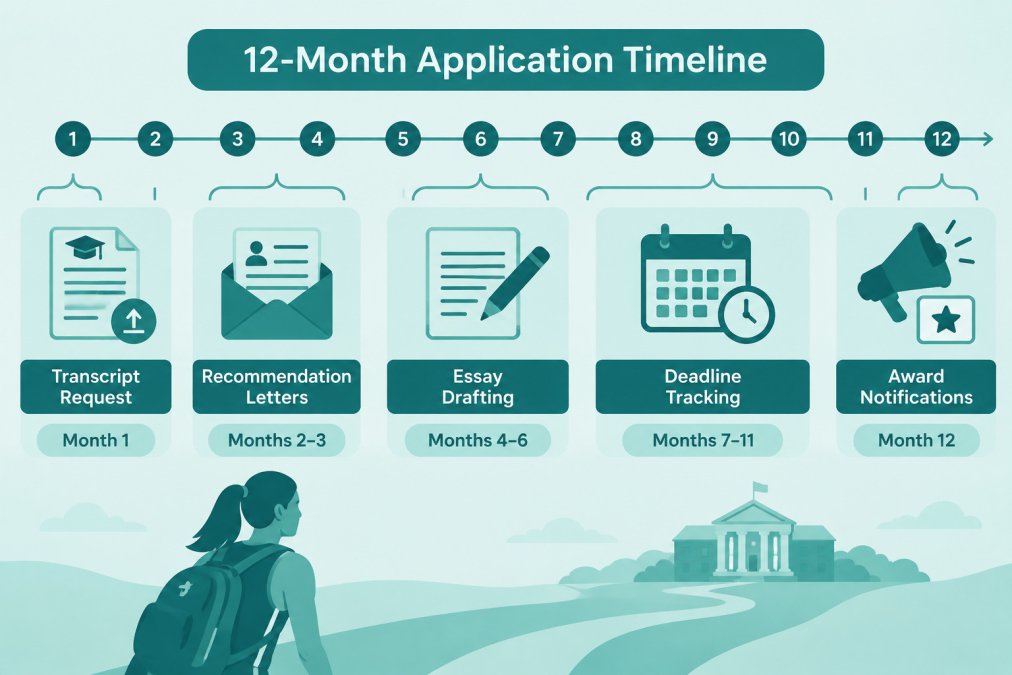
Plan your work across a 12-month window. Request transcripts early, since some schools take weeks to send them. Give recommenders at least four weeks' notice.
Step 4: Understand Award Terms, Renewals, and How Aid Affects Other Funding
An award letter is not the end of the process. The terms attached to a private fund determine whether the money actually reaches your tuition bill, whether it repeats next year, and whether it changes the rest of your financial aid package. Read the terms before you accept anything.
One-time versus renewable awards
Some private funds pay a single amount. Others renew each year, but only if you keep meeting conditions. Common renewal requirements include maintaining a minimum GPA, staying enrolled full time, continuing to compete in your sport, or submitting an annual progress report. A renewable award can be worth far more than a larger one-time award, so compare total value across four years, not just the first-year figure.
How the money is paid
Private funds disburse money in different ways, and the method affects your planning:
- Paid directly to the school: The sponsor sends funds to the financial aid office, which applies them to your account. This is the most common arrangement for institutional-style awards.
- Paid to the student: Some sponsors issue a check to you, which you then forward to the school or use for approved expenses.
- Reimbursement: Some funds reimburse documented expenses after you pay them, which means you need cash flow up front.
How private awards interact with college aid
This is where families get surprised. Many colleges reduce need-based grants when a student receives outside scholarship money.
Governing-body rules add another layer. Governing-body rules, such as those set by the NCAA, may limit athletic aid and affect how outside awards interact with it.
Watch out: Accepting a private award without notifying your financial aid office can create an overaward that the school must resolve, sometimes by reducing aid you were counting on.
Questions to ask before you sign
- Is the award one-time or renewable, and what are the renewal conditions?
- Does the money go to the school or to me, and which expenses does it cover?
- Does the sponsor report the award to my school, or do I need to?
Keep a copy of every award letter and the sponsor's terms in your records. If a term is unclear, ask the sponsor in writing before you accept.
The table below summarises the key award terms to check before you accept a private scholarship.
| Term | What to check | Why it matters |
|---|---|---|
| One-time award | Single payment only | Compare its value against renewable awards |
| Renewable award | Renewal conditions apply each year | Total value over four years can exceed a larger one-time award |
| Paid to school | Funds applied to your account | Most common for institutional-style awards |
| Paid to student | Check issued to you | You must forward funds or use them for approved expenses |
| Reimbursement | Expenses repaid after you pay | You need cash flow up front |
| Outside award | Reported to financial aid office | Can reduce need-based grants at many colleges |
Your Next Step: Set Up a Weekly Scholarship Search Routine
Searching once is not enough. Set aside one hour each week to search for new awards, check deadlines, and update your materials. Keep a simple tracker with the award name, deadline, requirements, and status.
Our Athlete Recruiting Resources for Every Stage include scholarship tips and outreach guidance you can use to keep this routine going.
Frequently Asked Questions
Can I have both an academic and athletic scholarship?
Often yes, but the combination depends on the school and the award rules. Many colleges coordinate institutional academic aid with athletic aid, and some private awards are allowed alongside both. Some schools reduce other aid when total awards exceed the cost of attendance. Ask the financial aid office how outside scholarships, athletic aid, and academic aid will be combined before you accept any offer.
Where can student-athletes find private scholarships?
Start with your high school counselor, your coach, local community organizations, sport-specific associations, and employers or unions connected to family members. Scholarship databases can help you filter by sport, state, and grade level. Search with specific terms like your sport, position, and state, and save a list of the awards you find along with their deadlines and eligibility rules.
How can I tell whether an athletic scholarship opportunity is legitimate?
A legitimate award will not ask you to pay a fee to apply or to receive the money, and it will name the organization offering it, its eligibility rules, and its selection process. Be cautious of guarantees of winning, pressure to act immediately, or requests for bank account numbers. Verify the sponsoring organization through its own website and a search of its name combined with the word scam.
What documents should I prepare when applying for student-athlete scholarships?
Most applications ask for an official transcript, a list of athletic achievements with video or stats, one or two recommendation letters, a short personal essay, and proof of financial need if the award is need-based. Keep digital copies of each document in one folder so you can submit them quickly as deadlines approach.