 how-to
Academic Eligibility for College Athletes: 2026 Guide
Table of Contents
- Why Academic Eligibility Decides More Recruiting Battles Than Film Does
- The NCAA Core Courses That Actually Count Toward Eligibility
- NCAA Eligibility Center Registration: What to Do and When
- College Athletic Eligibility by Division: DI, DII, and DIII Side by Side
- Your College Athlete Eligibility Timeline, From Freshman Year to Signing Day
- When You Fall Short: Waivers, Academic Redshirts, and Recovery Plans
- Amateurism Certification Is a Separate Fight From Academic Eligibility
- Conclusion
- Frequently Asked Questions
Last Updated: October 19, 2026
Why Academic Eligibility Decides More Recruiting Battles Than Film Does
Here at RecruitMyGame, we watch families pour thousands of dollars into highlight reels and showcase camps, and then we watch the same families get blindsided by a transcript problem that quietly kills the offer before a coach ever sees the film. That is why we treat academic eligibility for college athletes as the first filter in the recruiting process, not the last box you check on signing day. Academic eligibility is the set of academic standards the NCAA, NAIA, and NJCAA require a high school student-athlete to meet before they can practice, compete, or receive an athletic scholarship as a college athlete. The rules are set by the governing bodies themselves, so the NCAA Eligibility Center is the only place to confirm the current standards that apply to your class year. Plenty of talented athletes lose offers because their grades slipped in a single semester or a core course wasn't on the approved list. Coaches rarely tell you the real reason, but the paperwork does.
The NCAA Core Courses That Actually Count Toward Eligibility
NCAA core courses are the specific high school classes the Eligibility Center will count toward your certification, and only classes on your school's approved core-course list qualify, covering a set number of English, math, natural or physical science, social science, and additional academic units that varies by the division you're targeting. What most guides miss is that the list is school-specific, so a class that counts at one high school may not count at another, which means you should ask your counselor for your school's approved core-course list early, check it every year because it can change, and stay in the most rigorous version of each core subject your school offers.
NCAA Eligibility Center Registration: What to Do and When
NCAA Eligibility Center registration is the process of creating your account and submitting your academic records so the Eligibility Center can certify you, and you should start it at the beginning of your junior year. Once you're registered, request that your high school send official transcripts directly to the Eligibility Center, and do the same after graduation with your final transcript, because a transcript sitting in a counselor's inbox does nothing until it's actually sent, so keep your own copy of everything you submit.
College Athletic Eligibility by Division: DI, DII, and DIII Side by Side
College athletic eligibility by division comes down to how much academic proof each level requires, and the differences are bigger than most families expect. Division I has the most detailed standards and uses a sliding scale that balances your core-course GPA against your test scores, so a stronger GPA can offset a weaker test result and the reverse is also true; you need 16 core courses with a specific distribution (four years of English, three years of math at Algebra I or higher, two years of natural or physical science including at least one lab course if offered, one additional year of English, math, or natural/physical science, two years of social science, and four years of additional courses in English, math, natural/physical science, social science, foreign language, comparative religion, or philosophy), and your core-course GPA must be at least 2.3 on a 4.0 scale, though if you fall below that you can still qualify for an academic redshirt with a GPA of at least 2.0 plus the matching sliding-scale test score.
| Division | Certification Body | Core Courses Required | Minimum Core GPA | Test Score Role |
|---|---|---|---|---|
| Division I | NCAA Eligibility Center | 16 | 2.3 (2.0 for academic redshirt) | Sliding scale with GPA |
| Division II | NCAA Eligibility Center | 16 | 2.2 | Sliding scale with GPA |
| Division III | The school itself | None national | School admission standards | Set by the school |
| NAIA | NAIA Eligibility Center | None specified | 2.0 (or 3.0 for no-test path) | Minimum score or top-half class rank |
| NJCAA | NJCAA | Varies by division | Varies | Program dependent |
That table is a starting map, not a substitute for the official rulebook, and we tell every family the same thing: confirm the current standard for your specific class year before you build a plan around it, since the NCAA and NAIA occasionally adjust thresholds, so always download the current guide from the respective eligibility center website.
Your College Athlete Eligibility Timeline, From Freshman Year to Signing Day
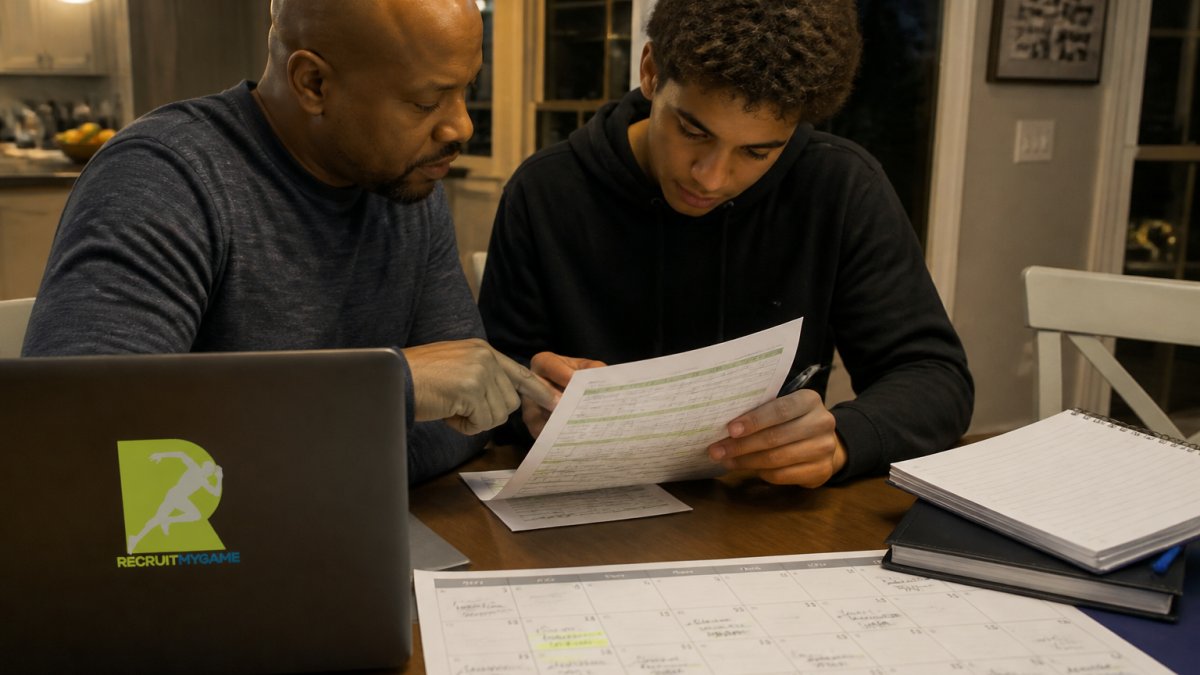
Your college athlete eligibility timeline starts the day you walk into ninth grade, because every core course you take from that point forward counts toward certification, with freshman and sophomore year for building your core-course GPA and staying on the approved list, junior year for registering with the Eligibility Center and getting transcripts sent, and senior year for finishing strong and submitting your final transcript.
Freshman year (fall): Meet with your high school counselor to get your school's approved core-course list and map out a four-year plan that includes the required core courses for your target division.
Sophomore year (fall): Continue monitoring your core-course progress and GPA. If you're struggling in a core class, seek help early and consider retaking it if necessary, because grade replacement policies vary by school.
Sophomore year (spring): Take the SAT or ACT for the first time if you've completed Algebra II, as the math section aligns with that level. You can retake it later, but having a baseline score helps you plan.
Junior year (fall): Register with the NCAA Eligibility Center (or NAIA Eligibility Center if applicable) at the start of the year, create your account, and request that your high school send your official transcript after your junior year is complete.
Junior year (spring): Send your official transcripts to the Eligibility Center after the school year ends and verify they have been received, take the SAT or ACT one more time if needed, and check the sliding scale to see where you stand.
Senior year (fall): Submit your final amateurism certification request if you haven't already, and continue to monitor your academic progress. Avoid senioritis, because your final transcript will be reviewed.
Senior year (spring): Request that your high school send your final official transcript to the Eligibility Center immediately after graduation. Check your eligibility status online and follow up on any missing documents.
- Confirm your school's approved core-course list with your counselor (freshman fall)
- Map out core courses for all four years (freshman fall)
- Take PSAT or practice ACT (freshman spring)
- Take SAT or ACT first time (sophomore spring)
- Register with the Eligibility Center (junior fall)
- Send official transcripts after junior year (junior spring)
- Retake any core course you failed before senior year ends (senior fall)
- Submit final transcript after graduation (senior spring)
When You Fall Short: Waivers, Academic Redshirts, and Recovery Plans
Falling short of the initial eligibility standard is not the end of your college sports career, but the recovery path depends on how far short you are and which division you're targeting. An academic redshirt lets a qualifying-but-not-fully-qualified athlete practice with the team in the first year while sitting out competition, and it preserves eligibility as long as you stay on track academically. A waiver is a formal request to the governing body for relief from a specific rule, and it is granted case by case, so nobody can promise you one. The most reliable recovery plan is boring: retake the core course you failed, use your high school's grade-replacement policy if it has one, and get your final transcript in early. If you're coming from a junior college, the transfer rules are their own puzzle, so talk to the compliance office at your target school before you assume your credits will carry over.
Amateurism Certification Is a Separate Fight From Academic Eligibility
Amateurism certification is a separate review from academic eligibility, and passing one does not mean you've passed the other, because the Eligibility Center evaluates whether you've accepted money, prizes, or benefits tied to your athletic ability on its own timeline with its own paperwork. Families often assume a clean transcript settles everything, then get stuck waiting on amateurism status while a coach waits on them, so keep records of any prize money, stipends, or benefits you've received, disclose them honestly, and start the amateurism review at the same time you start your academic file.
Conclusion
The families who come out ahead in recruiting are rarely the ones with the best film alone, because the athletes who actually get to compete are the ones who treated their transcript as seriously as their training schedule. RecruitMyGame was built to take the guesswork out of the rest of the process, with AI-powered college matching that looks at real roster needs and graduation timelines, verified coach and teacher reviews, recruiting analytics that show you how coaches are actually engaging with your profile, and a personalized web address and QR business cards that make it easy for a coach to pull up your film and academics in one tap. Get started with RecruitMyGame and put your energy into the parts of recruiting you can actually control.
Frequently Asked Questions
What are the academic requirements to play college sports?
It depends on the division, but the building blocks are the same: a set number of core courses in English, math, science, social studies, and foreign language, a core-course GPA on a 4.0 scale, and for Division I and II, a test score that pairs with that GPA on a sliding scale. You also have to graduate high school and complete an amateurism certification. Division III programs set their own admissions and eligibility rules, so check with each school directly. The safest move is to review the current requirements on the NCAA Eligibility Center site before your junior year, since the standards get updated periodically.
Do college athletes need to register with the NCAA Eligibility Center?
Yes, if you want to compete at a Division I or Division II school. NCAA Eligibility Center registration is how the clearinghouse collects your transcripts, confirms your core courses, and issues your final eligibility status. Most families create an account during sophomore or junior year so transcripts can be sent early and any missing core courses get flagged while there is still time to fix them. Division III prospects generally do not need to register, but many still do because it keeps options open if a DI or DII offer comes late. Registration alone does not make you eligible; it just starts the review.
Can you play college sports if you do not meet NCAA academic requirements?
Sometimes, but the path narrows. Division I has an academic redshirt option for prospects who meet a lower threshold: you can practice and receive an athletic scholarship but cannot compete during your first year. Prospects who fall below even that line may need to sit out, attend a junior college to build a transferable record, or pursue a waiver. Division II has its own partial-qualifier rules that allow practice and scholarship in the first year. The earlier you know where you stand, the more options you keep, so get a transcript review done before your senior year rather than after.
How long does college athletic eligibility last?
The standard clock is five calendar years to compete in four seasons, and the clock starts when you enroll full time at any college, not when you first step on the field. Redshirt years, injury waivers, and medical hardship petitions can extend or pause that window, but they require documentation and approval. Transferring does not reset the clock, though transfer rules and season-of-competition rules have changed in recent years, so confirm the current policy with the compliance office at the school you are considering. Academic eligibility and the five-year clock are two separate tests you have to pass.