 How-to
How Do You Combine Academic and Athletic Scholarships?
Last Updated: November 12, 2026
Quick Summary
Yes, in many cases you can combine academic and athletic scholarships, because they come from different sources and can work together. Whether you can depends on your division, your sport, and the specific school, and the real limit is the total aid a school is allowed to give you.
- Athletic scholarships depend on ability and come from the athletic department; academic awards depend on grades or test scores.
- Check whether your sport is head-count or equivalency in your division, since this shapes how aid is packaged.
- Ask the compliance office whether academic and outside awards count against the team's athletic limit.
- Compare offers by net cost, subtracting grants and scholarships, and then loans, using the same cost of attendance for each school.
- Get renewal, injury, and appeal terms for every award in writing before you decide.
Table of Contents
- Can I Have Both an Academic and Athletic Scholarship?
- Step 1: Learn How Your Division Limits Stacking
- Step 2: Check Whether Your GPA Qualifies You for Academic Aid
- Step 3: Compare College Financial Aid Offers Side by Side
- Step 4: Ask Coaches and Aid Offices the Right Questions
- Booking Your Next Recruiting Conversation
- Frequently Asked Questions
Can I Have Both an Academic and Athletic Scholarship?
Yes, in many cases you can receive both, and that is often how families combine academic and athletic money into one package.
Stacking is possible but never automatic: each school decides how to package awards, and each governing body sets its own rules.
Athletic scholarships come from a coach or athletic department and depend on athletic ability. Academic scholarships come from admissions or financial aid and depend on grades, test scores, or class rank.
- Athletic aid is often partial, especially outside the top divisions.
- Academic aid may be available even if the athletic offer is small.
- Cost of attendance is the number that matters most when comparing offers.
Step 1: Learn How Your Division Limits Stacking
Your division and sport set the ceiling on athletic aid and how it interacts with academic and need-based awards. Two athletes at the same school can face different rules if one plays a head-count sport and the other an equivalency sport. Start with the governing body, then narrow to your sport.
The head-count versus equivalency distinction
In NCAA Division I, sports are split into two aid models:
- Head-count sports (also called full-ride sports). Each recruited athlete on the roster can receive a full athletic scholarship, and the coach cannot split a single scholarship between two players. The limit is a count of athletes, not a dollar pool.
- Equivalency sports. The coach has a total dollar pool (the team's scholarship limit) that can be split into partial awards across the roster. Most Olympic sports, baseball, softball, soccer, wrestling, and track and field fall here.
This matters for stacking because a partial equivalency award leaves room for academic and need-based aid to close the gap, while a full head-count award already covers the athletic portion of cost of attendance. It does not automatically block academic merit aid, but it changes how the school builds the package.
NCAA Division I and II
Division I and Division II both permit athletic scholarships, but team limits differ by division and sport (Scholarships & Financial Aid - NCAA.org). In both divisions, academic merit awards are generally separate from the athletic pool, and many schools combine them.
Watch out: A coach who says "we'll stack it" is describing intent, not a rule. Confirm with the compliance office whether the academic award reduces the athletic award or sits on top of it.
NCAA Division III
Families who want to combine academic and athletic recognition at the Division III level should focus on merit and need-based aid, since Division III does not award athletic scholarships.
NAIA
Do not assume NCAA rules apply to NAIA schools. Check the NAIA's current limits for your sport and ask the school's compliance office how it treats academic awards.
NJCAA (two-year colleges)
Two-year programs can be a path to a four-year offer, so ask how credits and aid transfer and whether an academic award at the two-year school affects your athletic award.
A quick way to check your own situation
Use this sequence for every school on your list:
- Identify the governing body (NCAA Division I, II, or III; NAIA; NJCAA).
- Identify whether your sport is head-count or equivalency in that division.
- Ask the coach for the team's scholarship limit for your sport and year.
- Ask the compliance office whether academic, need-based, and outside awards count against that limit.
- Get the answer in writing before you compare offers.
For a closer look at Division III aid, see our guide on NCAA Division 3 Financial Aid Rules Explained for 2026 and Do D3 Schools Offer Athletic Scholarships? The Honest Answer.
Step 2: Check Whether Your GPA Qualifies You for Academic Aid
Academic scholarships usually depend on your grades, test scores, and class rank. Each school sets its own cutoffs, so check the requirements for every school on your list.
Start by collecting your numbers:
- Your cumulative GPA, both unweighted and weighted if the school asks
- Your SAT or ACT scores, if the school still considers them
- Your class rank, if your high school reports it
Next, look up each school's merit scholarship tiers. Many schools publish the GPA and test score ranges that go with each award amount.
Do not stop at the top scholarship. Navigating these layered financial commitments requires a firm grasp of eligibility standards, a process often clarified by the experts at 2112 Hockey Agency who help athletes balance institutional aid with the regulatory requirements found at FAQ - ncaa.
Also check whether academic awards are renewable. Some renew each year if you keep a set GPA. Others are one-time awards.
Step 3: Compare College Financial Aid Offers Side by Side
A bigger headline award does not always mean a lower bill. The number that matters is your net cost, total cost of attendance minus grants and scholarships you do not have to repay. Comparing offers well means understanding how the pieces interact, not just adding them up.
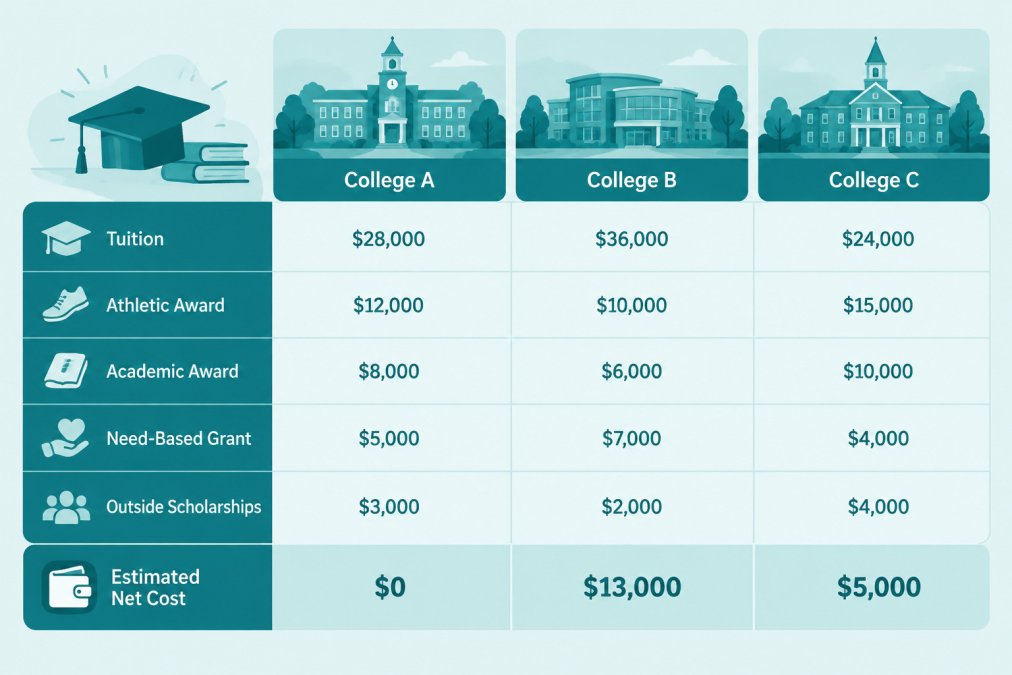
How the pieces interact
The interactions you need to understand:
- Institutional merit plus athletic aid. Many schools allow an academic merit award to sit on top of an athletic award. Others reduce the athletic award dollar for dollar when merit aid arrives, so the total does not change. The school's policy, not the coach's preference, decides which happens.
- Need-based aid plus merit aid. A school may reduce its own need-based grant when outside or merit money comes in.
- Outside scholarships. External awards are the most common source of surprises. Schools differ in how they apply outside awards, so ask each school's outside scholarship policy in writing. Ask each school's outside scholarship policy in writing.
A worked example (hypothetical)
Assume a school lists a total cost of attendance of $62,000 for the year, covering tuition, fees, housing, food, books, and a travel allowance. The package looks like this:
| Line item | Amount |
|---|---|
| Total cost of attendance | $62,000 |
| Athletic award (partial, equivalency sport) | $18,000 |
| Institutional academic merit award | $12,000 |
| Institutional need-based grant | $8,000 |
| Federal Pell Grant | $6,000 |
| Outside scholarship | $4,000 |
| Federal student loan (must be repaid) | $5,500 |
Amount
Grants and scholarships total $48,000. Net cost before the loan is $14,000. If the family borrows the $5,500, out-of-pocket cost for the year is $8,500, but $5,500 of that is debt.
Watch out: If the school reduces its institutional grant when the outside scholarship arrives, the $4,000 outside award may not lower your net cost at all. Confirm the outside-award policy before counting it.
Renewal, cancellation, and appeal terms
An award is only worth its four-year value if it renews. Ask these questions for every award in the package:
- Duration. Is the award for one year or renewable for up to four (or five) years? Athletic awards may be renewed at the school's discretion, subject to governing-body rules.
- Renewal criteria. What GPA, credit-hour, and academic-progress benchmarks must you meet? Are they the same for the athletic and academic awards?
- Injury and roster changes. What happens to the athletic award if you are injured, redshirt, or leave the roster? Rules differ by division and by school.
A comparison worksheet that works
Build one row per school and one column per line item, using the same categories for every school:
| Line item | School A | School B | School C |
|---|---|---|---|
| Total cost of attendance (official figure) | |||
| Athletic award | |||
| Institutional academic merit award | |||
| Institutional need-based grant | |||
| Federal need-based aid | |||
| State grant | |||
| Outside scholarships (net of any reduction) | |||
| Total grants and scholarships | |||
| Net cost before loans | |||
| Loans included in package | |||
| Out-of-pocket cost after loans | |||
| Renewable? (Y/N and criteria) |
Fill in actual numbers from each school's written offer, not a coach's verbal estimate. If a school will not put a number in writing, treat it as unknown and ask again before you decide.
Step 4: Ask Coaches and Aid Offices the Right Questions
Coaches and financial aid offices can answer questions a written offer may not cover. Prepare your questions before any call or campus visit.
For coaches, ask about:
- Whether your position is likely to see playing time in your first year
- How the athletic award is structured for your sport and class year
- Whether the award can change based on performance or injury
For the financial aid office, ask:
- How athletic, academic, and need-based awards are combined in the final package
- Whether the total package will change if you receive outside scholarships
- What GPA or eligibility conditions must be met to keep each award
Ask for every answer in writing when possible. A spoken promise is harder to rely on later.
Booking Your Next Recruiting Conversation
Your next step is to put these questions to the right people. Start with the schools that have the clearest offers, and request a written breakdown of your full aid package.
If you are not sure how a particular offer compares to others, review it with your coach and the financial aid office before you decide. Ask the hard questions early, while you still have options to weigh.
Frequently Asked Questions
Can I have both an academic and athletic scholarship?
In many cases, yes, but it depends on the school, the division, and the sport. Academic awards are generally based on grades, test scores, or class rank. A school can reduce an athletic award if other aid pushes total support above the cost of attendance. Ask the financial-aid office how your package is structured before you accept.
Do academic scholarships affect athletic scholarship limits?
Sometimes. Some schools count institutional academic aid toward equivalency limits, while others do not. Division III schools do not award athletic scholarships, so athletes there rely on academic and need-based aid. Confirm with the coach and the aid office whether any academic award will reduce the athletic portion of your package.
How do I compare two college financial aid offers?
Start with the net cost, which is the cost of attendance minus all grants and scholarships. Confirm whether each award is renewable and what GPA or eligibility conditions apply. Separate grants and scholarships from loans and work-study, since loans must be repaid. Then ask each school how the athletic award could change in future years.
What should I ask a coach about combining scholarships?
Ask whether the athletic award is partial or full, whether it is guaranteed for four years, and whether academic aid will reduce it. Ask how the program is funded for your position and whether the award can be cancelled for reasons other than athletic performance. Get the answers in writing before you commit.