 ultimate-guide
Navigating Federal Grants for College Athletes: A Full Guide
Last Updated: November 5, 2026
Quick Summary
Federal grants are need-based money for college that you don't repay, and college athletes can qualify for them too. Your athletic scholarship and federal grants run on separate tracks, so filing the FAFSA is the step that opens the door. Being recruited doesn't disqualify you from federal grants like the Pell Grant.
- Federal grants like the Pell Grant are based on financial need, not athletic ability.
- File the FAFSA even if you expect a full athletic scholarship, since schools use it for aid decisions.
- Create your StudentAid.gov account before filing. You can generally begin completing the FAFSA immediately, although some identity verification may take additional time.
- Athletic scholarships and federal grants share a ceiling: your school's cost of attendance.
- Ask your aid office how it handles overawards before you accept a package.
Table of Contents
- What Federal Grants Actually Mean for College Athletes
- Types of Financial Aid Available to Student-Athletes
- Pell Grant Eligibility for Student-Athletes: Who Qualifies and Why
- FAFSA for Student-Athletes: A Step-by-Step Walkthrough
- Student-Athlete Scholarships for High School Seniors: What to Expect
- How Athletic Scholarships Interact With Federal Grants
- Financial Aid Options for Student-Athletes Beyond Federal Grants
- Renewal, Satisfactory Academic Progress, and Changes in Eligibility
- Your Next Step: Building a Federal Aid Timeline Before Senior Year
- Frequently Asked Questions
What Federal Grants Actually Mean for College Athletes
Federal grants are money for college that you don't pay back, and that includes if you're a college athlete. Plenty of athletes assume their athletic scholarship covers everything, so they never look at federal aid, and that's a costly mistake: many of them would qualify for federal grants but leave that money on the table.
Here's the part most people miss: federal grants and athletic scholarships are not competing for the same pot of money. Many athletes can receive both, though how they fit together depends on your financial need and your school's rules. Federal grants are based on need, not athletic ability. For practical strategies on building a stronger overall aid package, see strategies for building a stronger aid package.
So when you're navigating federal grants, start by understanding that they are a separate track. Your athletics department and your school's financial aid office each administer their own piece of the puzzle, under their own rules. You need to work with both.
Types of Financial Aid Available to Student-Athletes
Athletes usually have access to several kinds of aid, and each works differently. Knowing the categories helps you ask the right questions when offers come in.
Federal grants are the first category most families look at. These include the Pell Grant and the Federal Supplemental Educational Opportunity Grant, usually called FSEOG.
Athletic scholarships come from the school's athletic department and are tied to your sport. They can be full or partial, and the amount is negotiated.
Institutional aid comes from the college itself. This can include merit scholarships, need-based grants, and tuition waivers that aren't tied to your sport.
Some aid comes from outside sources, like state grants or private scholarships from community organizations. Check these too, because they often have their own deadlines.
Federal Work-Study is another option. It pays you for part-time work, usually on campus, and the job has to fit around your practice and game schedule.
Pell Grant Eligibility for Student-Athletes: Who Qualifies and Why
The Pell Grant is the largest federal grant for undergraduates with financial need. Being an athlete doesn't disqualify you, and it doesn't automatically qualify you either. Eligibility comes down to your family's financial information reported on the FAFSA.
Your Student Aid Index, or SAI, is the number the federal formula uses to decide Pell eligibility. A lower SAI generally means a higher grant. Your family size, income, and assets all feed into that number.
Athletes sometimes assume a big scholarship offer rules out a Pell Grant. It doesn't. The Pell Grant is calculated on need, and athletic scholarships are awarded based on athletic recruiting priorities and institutional policies. Both can appear on your financial aid award letter, and your school's aid office sorts out how they interact.
For the exact current maximum award amount and income thresholds, check the official Federal Student Aid website. Those numbers change yearly, so check the official source for current figures.
FAFSA for Student-Athletes: A Step-by-Step Walkthrough
The Free Application for Federal Student Aid, or FAFSA, is the gateway to nearly every federal grant. You have to file it before you can receive any federal aid, and athletes often delay it because they assume they won't qualify. File it anyway. Schools often use it to determine institutional aid too, and some athletic departments use it when building a package.
What makes the athlete version different is timing. Your recruiting timeline and your financial aid timeline run on separate tracks, and if you don't coordinate them you can miss deadlines while you're busy taking visits. Here's how to approach it:
- Create your FSA ID early. Both you and one parent, if applicable, need one. This is your electronic signature, so keep it safe. Create your StudentAid.gov account before filing. You can generally begin completing the FAFSA immediately, although some identity verification may take additional time. Do this in the fall of your junior year if you can, so it's ready well before you want to file.
- Gather your documents. You'll need tax returns, W-2s, bank statements, and records of untaxed income. If your parents are divorced or separated, know which parent fills out the form, because the rules on that changed recently and getting it wrong means a correction later.
- Fill out the form for the correct school year. Use the form for the upcoming academic year, not the one that just ended. The FAFSA typically opens in the fall for the following year, so if you're a senior, you're filing for next year, not this one.
- List every college you're considering. Schools receive your FAFSA data, so include every school on your list, including the ones recruiting you. You can add schools later, but it's easier to list them up front.
- Submit and track your status. Watch for a confirmation email, and check whether your school needs any additional verification documents. Verification is common, and it can delay your award if you don't respond quickly.
- Follow up with each aid office. Once your FAFSA is processed, contact the financial aid office at each school on your list and confirm they received it. This is also your chance to ask whether they need anything else from you as a recruited athlete.
Watch out: missing a school's priority deadline can cost you money even if the federal deadline is later. Many state and institutional grants run on earlier timelines, so check with each athletic and financial aid office.
One more athlete-specific step: tell your coach and the athletic department that you've filed. Some programs track whether recruits have completed the FAFSA. Confirm with the recruiting staff whether they need notification that your FAFSA is complete.
Here is a quick reference for the FAFSA steps and when each one is due, so you can keep your filing on track alongside recruiting.
| Step | What to do | Time or frequency |
|---|---|---|
| Create your FSA ID | Set up one for you and a parent, if applicable | Fall of junior year, since it takes a few days |
| Gather documents | Tax returns, W-2s, bank statements, untaxed income records | Before you start the form |
| Fill out the correct form | Use the form for the upcoming academic year | Opens in the fall for the following year |
| List every college | Include all schools you're considering, including recruiting schools | When you file |
| Submit and track status | Watch for confirmation and any verification requests | Respond quickly to verification |
| Follow up with aid offices | Confirm each school received your FAFSA and ask about other needs | Once your FAFSA is processed |
Student-Athlete Scholarships for High School Seniors: What to Expect
If you're a high school senior hoping for an athletic scholarship, expect the process to move faster than you think. Coaches often make decisions during your junior year and the early part of senior year, so your recruiting timeline matters.
Scholarship offers vary widely. Some sports, like football and basketball at certain levels, can offer full scholarships. Many other sports split their scholarship money among several athletes, which means partial awards are common.
Put every offer in writing. Our guide on evaluating what each offer actually includes walks you through the details to check. Ask the coach or athletic department to confirm the amount, the length of the award, and whether it is renewable each year.
Finding the right programs takes effort. You can also see how to find real athletic scholarship opportunities that match your level and sport.
How Athletic Scholarships Interact With Federal Grants
This is where things get complicated, and where most of the confusion lives. Your athletic scholarship and your federal grants don't cancel each other out in general, but they do share a ceiling, and that ceiling is your school's cost of attendance.
Here's the basic logic. Your school calculates your cost of attendance, which covers tuition, housing, food, books, and some personal expenses. Then it subtracts the aid you're receiving.
The FAFSA sits at the center of this. Your reported finances determine your federal eligibility, and your school then layers its own aid on top.
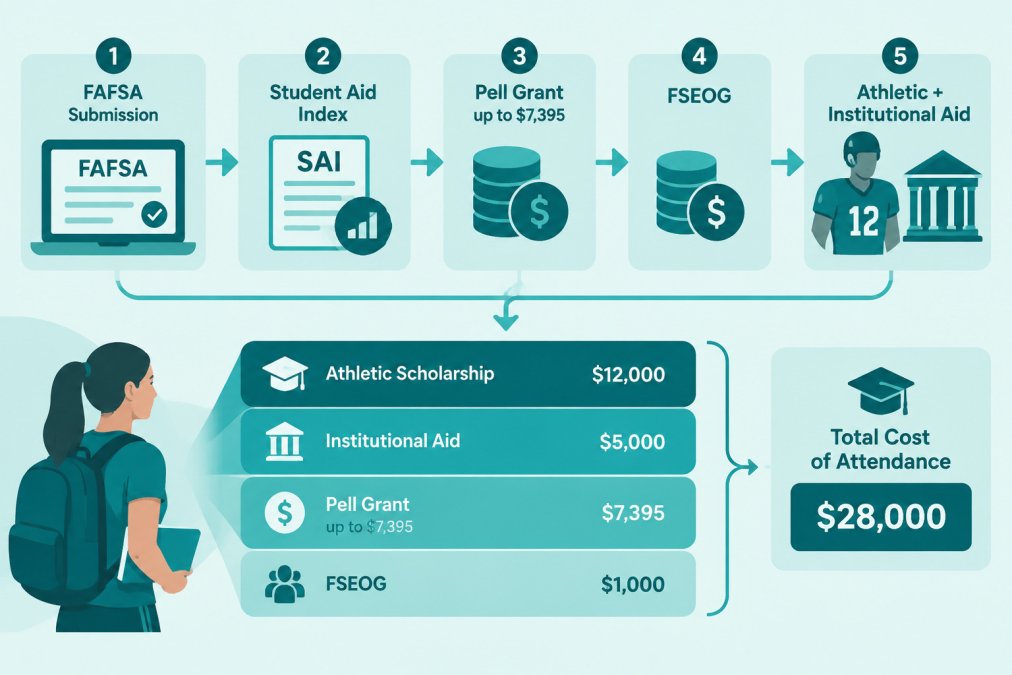
One thing that trips up a lot of families is mixing up two different rulebooks. Federal aid rules come from the U.S. Department of Education and govern things like the Pell Grant and FSEOG.
Another piece people miss is that the order in which aid is applied matters.
Worked Example: Combining an Athletic Scholarship and a Pell Grant
Say you receive a partial athletic scholarship covering a set amount per year. Your FAFSA shows financial need, and your school determines you're eligible for a Pell Grant. Your school's cost of attendance is set by the school each year.
Here's how the numbers might work out. This is an illustrative calculation, not an eligibility determination or an actual aid offer:
| Annual cost of attendance | $28,000 |
| Athletic scholarship | -$12,000 |
| Pell Grant | -$5,000 |
| Remaining cost | $11,000 |
That remaining cost is what loans, work-study, family contribution, or additional grants would need to cover. Loans and work-study are different from grants and scholarships, since they aren't free aid, and only your aid office can determine your actual eligibility and how your remaining cost gets filled.
Athletes may qualify for Pell Grants alongside athletic scholarships. How the awards interact depends on the types of aid involved and applicable federal and institutional rules. Ask the financial aid office which awards, if any, would be adjusted.
Watch out: some athletes assume a full athletic scholarship makes them ineligible for a Pell Grant, so they skip the FAFSA entirely and never find out they could have received grant money for books and living expenses.
Financial Aid Options for Student-Athletes Beyond Federal Grants
Federal grants are only one piece. Plenty of athletes build a stronger package by combining several sources.
State grants are often overlooked. Many states run their own need-based programs, and some have deadlines that come well before the federal ones. Check your state's higher education agency.
Private scholarships from community groups, local businesses, and national organizations can add real money. Many are small, but stacking several together adds up. Search regularly and prioritize legitimate scholarships for which you meet the eligibility requirements.
Ask the financial aid office about institutional need-based grants. Some schools fund these separately from athletic aid, and they can reduce your balance meaningfully.
Work-study and part-time jobs can cover personal expenses without adding debt. Just remember that the hours need to fit your training schedule.
Renewal, Satisfactory Academic Progress, and Changes in Eligibility
Getting aid in year one doesn't guarantee it in year two. Most athletic scholarships are renewed one year at a time, and renewal can depend on your athletic performance, roster decisions, and your academic standing.
Federal aid carries its own requirement called Satisfactory Academic Progress, or SAP. Your school sets the standard, but it generally involves maintaining a minimum GPA and completing a minimum share of the credits you attempt. Fall below that standard and you can lose eligibility until you recover.
Changes in your situation can also change your aid. A shift in family income, a move between schools, or a change in your enrollment status can all require updated paperwork. Report changes promptly, because they can affect both your federal and institutional awards.
Keep your grades up, communicate with your coach and aid office, and review your award letter every year. You can also verify NCAA clearinghouse eligibility requirements yourself in about an hour. Renewal is not automatic.
Your Next Step: Building a Federal Aid Timeline Before Senior Year
Waiting until the spring of senior year to think about federal aid is too late. Start building your timeline now. Mark the FAFSA filing window, each school's priority deadline, and the dates for state and private scholarship applications on one calendar.
Then sit down with your family and gather the tax and income documents you'll need. Create your FSA ID early so no delay catches you at the last minute. Start a list of every school you're considering and note whether each one offers athletic aid, institutional grants, or both.
Keep the aid offices in the loop, and treat every deadline as real. If you want help matching with programs that have genuine roster needs at your position, RecruitMyGame can help you narrow the field so your time goes to programs that may align with your athletic profile and recruiting goals.
Frequently Asked Questions
Can college athletes receive federal grants?
Yes. Student-athletes are eligible for the same federal grants as any other undergraduate, including the Federal Pell Grant and the Federal Supplemental Educational Opportunity Grant (FSEOG). Pell Grants are awarded based on financial need according to a set federal formula, while FSEOG funds are limited and distributed at each school's discretion based on its own institutional funding availability. Eligibility is based on financial need and enrollment status, not on whether you play a sport. Athletic status does not disqualify you. What matters is whether you file the FAFSA, meet the school's requirements, and remain enrolled at least part time in an eligible degree program.
Does an athletic scholarship affect eligibility for federal student aid?
It can. Federal need-based aid is calculated using your total resources, and under federal rules a scholarship that covers tuition and fees generally counts toward your financial aid package. Your school's financial aid office will combine your athletic award, grants and loans into a total package and check it against your cost of attendance. Once the total exceeds that cost, aid may be reduced, so ask the aid office to walk you through the numbers before you commit.
Do college athletes need to complete the FAFSA?
In most cases, yes. Completing the Free Application for Federal Student Aid is the gateway to Pell Grants, FSEOG and federal loans, and many schools also use it to award their own institutional aid. Even athletes who expect a full athletic scholarship should file, since a need-based grant can cover costs the athletic award does not, such as housing, books and travel. Submit it early, because some aid is awarded on a first-come basis.
Can student-athletes receive Pell Grants?
Yes, as long as you demonstrate financial need, are enrolled in an eligible program and are making satisfactory academic progress. Pell Grant amounts depend on factors including your Student Aid Index (SAI), cost of attendance, enrollment intensity, and remaining Pell eligibility. A student-athlete with a partial athletic scholarship may still qualify for a Pell Grant to cover remaining costs. The 2026-27 maximum scheduled Pell Grant award is $7,395, according to Federal Student Aid, though this is a maximum and not a guaranteed amount. Check your school's financial aid office for your actual award and how athletic aid is factored in.
What is the difference between an athletic scholarship and a federal grant?
An athletic scholarship is awarded by a college based on your athletic ability and the team's needs, and it usually comes with a commitment to play. A federal grant, such as a Pell Grant, is awarded by the government based on financial need. The two are independent, so you can often receive both, though the school will combine them into one aid package and may reduce other aid if the total exceeds your cost of attendance.
What GPA will get you a full ride scholarship?
There is no single GPA that guarantees a full athletic scholarship. Coaches look at athletic performance first, but academic eligibility is set by the NCAA and your school, and strong grades can widen your options, including academic and need-based awards. Aim for a GPA that clears NCAA initial-eligibility minimums and stay consistent through senior year, since your transcript shapes both your eligibility and the institutional aid you can receive.
How do student-athletes stay eligible for federal grants year to year?
You need to reapply by filing the FAFSA each academic year, and you must maintain satisfactory academic progress, which means meeting your school's standards for GPA and completion rate. Changes in enrollment, such as dropping below part-time status, or changes in family income can alter your award. If your circumstances change, contact the financial aid office, since many schools allow appeals or a fresh review.